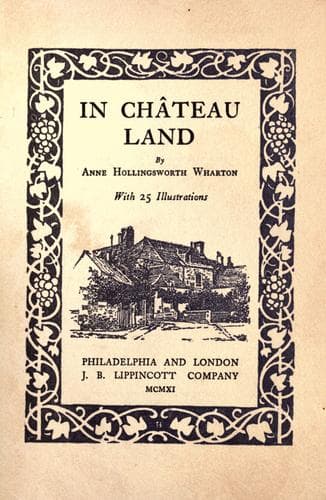
Castles -- France; Touraine (France) -- Description and travel
Another familiar and even more recent figure associated with Chaumont is
Madame de Stael, who took refuge here, while reading the proofs of her
work upon Germany, Chaumont being the requisite forty leagues from
Paris. M. Le Ray and his family, with whom Madame de Stael was upon the
most intimate terms, were in America at this time. Here in the old
chateau the De Staels lived for some time, the authoress working in
peace and quietness upon her great work. When M. Le Ray and his family
returned to Chaumont, although hospitably invited to remain at the
chateau, Madame de Stael insisted upon removing with her family to a
villa in the neighborhood, which was placed at her disposal by M. de
Salaberry. At this place, called Fosse, Madame de Stael welcomed Madame
Recamier and other friends, and with the charming French trait of making
the most of the joys of the hour, she wrote with enthusiasm of the happy
days that she passed near her friends at Chaumont. Even if the old
Vendean soldier, the chatelain of Fosse, took little care of his estate,
she said that his constant kindness made everything easy and his
original turn of mind made everything amusing. "No sooner had we
arrived," wrote Madame de Stael, "than an Italian musician whom I had
with me, to give lessons to my daughter, began to play the guitar. My
daughter accompanied on the harp the sweet voice of my fair friend,
Madame Recamier; the peasants assembled below the windows astonished to
find this colony of troubadours who came to enliven the solitude of
their master. It was there that I passed my last days in France, with a
few friends whose memories are cherished in my heart. Surely this
reunion so intimate, this solitary sojourn, this delightful dalliance
with the fine arts could hurt no one."
Charming, innocent, pastoral seems this life, as Madame de Stael
described it, and yet even such simple pleasures as these she was not
allowed to enjoy, for during a brief visit to the home of M. de
Montmorency, an attempt was made to seize her manuscripts, which her
children had fortunately put in a place of safety; her book was
suppressed and she was ordered to leave France within three days.
When Madame de Stael asked why she was treated with such harshness by
the government and why her book was censured, the answer given under the
signature of the ministry plainly stated that the head and front of her
offending consisted in her not having mentioned the Emperor in her last
work. It is difficult to believe that a man who could do such great
things as Napoleon could be so small as to follow this brilliant woman
with bitter, relentless hatred, because she failed to burn incense at
his shrine.
Public-domain text, read in full here on John Shaqi.
Reviews
Reviews
No reviews yet
Be the first to share your thoughts on this work.
Elsewhere in the archive
Join the Discussion
Join the discussion
Sign in to leave a comment or review.
Sign InorCreate an account