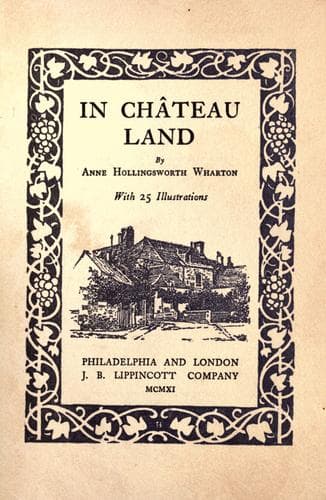
Castles -- France; Touraine (France) -- Description and travel
Even after these earnest words from Joan, the King, although impressed,
was not convinced, and with some reluctance allowed her to remain at
Chinon. We were afterwards shown the lodgings, which this inhospitable
royal host gave to the persistent visitor, in a very thick-walled little
tower, and according to our guide, Joan could get in or out of her room,
on an upper floor, only when her guards put a ladder up to her small
window, permanent stairways being considered unsafe for such guests.
The King saw Joan again several times. She did not delude herself as to
the doubts he still entertained. "Gentle Dauphin," she said to him one
day, "Why do you not believe me? I say unto you that God hath compassion
on you, on your kingdom and your people; St. Louis and Charlemagne are
kneeling before Him, making prayer for you, and I will say unto you, so
please you, a thing which will give you to understand that you ought to
believe me." Charles gave her audience on this occasion, in the
presence, according to some accounts, of four witnesses, the most
trusted of his intimates, who swore to reveal nothing, and, according to
others, completely alone. "What she said to him there is none who
knows," wrote Alan Chartier a short time after [in July, 1429], "but it
is quite certain that he was all radiant with joy thereat, as at a
revelation from the Holy Spirit."
Archie, who read the most recent life of Joan of Arc, on the steamer, as
a preparation for Chinon, reminds us that after much sifting of history
and tradition, it has been decided by learned authorities that the
revelation of the Maid, which filled the King with joy, was a positive
assurance that he was the rightful heir to the throne of France and the
true son of his father, Charles VI.
It is not strange that Charles VII should have doubted his own paternity
with a mother as unnatural and depraved as Isabel of Bavaria, and that
with a kingdom chiefly in the hands of the English he should have
seriously questioned his right and title to the throne, being himself of
a weak and doubting nature. It is said, that in an hour of great
despondency, Charles prayed to God from the depths of his heart that if
he were the true heir of the house of France, and the kingdom justly
his, God would be pleased to help him and defend it for him. This
prayer, which he thought known to God alone, the Maid recalled to the
mind of the King, thus giving the sign and seal of her mission, and by
this revelation she not only caused the King to believe in her, but
strengthened his confidence in himself and in his right and title. True
to herself and "the voices," for she never spoke as of her own motion,
it was always a superior power speaking through her, as the mouthpiece.
She said: "I tell thee on behalf of my Lord that thou art the true heir
of France and son of the King."
Public-domain text, read in full here on John Shaqi.
Reviews
Reviews
No reviews yet
Be the first to share your thoughts on this work.
Elsewhere in the archive
Join the Discussion
Join the discussion
Sign in to leave a comment or review.
Sign InorCreate an account