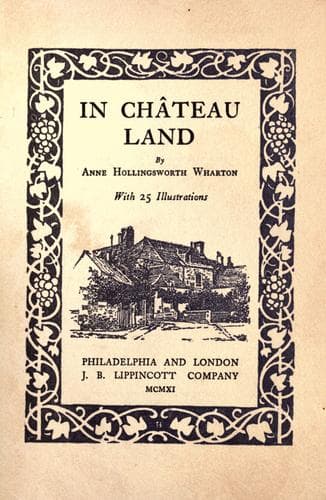
Castles -- France; Touraine (France) -- Description and travel
As we left Fontevrault and motored down the hill towards the Loire, M.
La Tour recalled to us the ancient glory of this abbey, whose walls now
echo to the clank of arms instead of to the _Ave Marias_ of the gentle
sisters. Fontevrault was founded in the eleventh century by Robert
d'Abrissel, a monk, as a place of refuge for a vast and ill-assorted
company of men and women who gathered around him when he was preaching a
crusade to Palestine. From this strange beginning the abbey became one
of the most famous in Christendom, as it was richly endowed by kings and
princes, especially by the early English kings who loved this beautiful
valley of the Loire. Many noble and royal ladies presided over
Fontevrault, among them, Renee de Bourbon, sister of Francis I who,
while she was Abbess, rebuilt the beautiful cloister which we saw
to-day. Another and later Lady Abbess was Marie Madelaine Gabrielle de
Rochechouart, who found time in the midst of her religious duties to
make translations of some of Plato's works. New ideas, you see, were
finding their way into the convent, it being the fashion about that time
for women to be learned, Mary Stuart having led the way by delivering a
Latin oration at the Louvre to the edification of all who heard her. And
here came Mary Stuart herself, while Louise de Bourbon was Lady Abbess,
brought hither by her aunt, the Duchess of Guise, to charm and delight
the nuns by her beauty and ready wit. As a religious establishment for
men and women, ruled over solely by a woman, the Abbey of Fontevrault
was unique in Christendom.
[Illustration: FRENCH CAVE DWELLINGS NEAR SAUMUR]
As we motored along the river bank beyond its low-lying sand marshes and
line of small hills, we noticed tiny black wind-mills spreading out
their arms to the breeze, and wreaths of smoke curling up from the
cliffs. Here and there the lowering sun would light up a window pane in
the cliff, as if to remind us that these hillsides are burrowed out by
the workers in the vineyards who make their homes here as in Touraine
and in the valley of Vendomois.
"It seems that we are again in the land of the troglodytes," said
Walter. "Alfred de Vigny says these peasants 'in their love for so fair
a home have not been willing to lose the least scrap of its soil, or the
least grain of its sand.' I think myself that it is for more practical
and economic reasons that they live underground."
These cliff dwellings continue for nearly eight miles around Saumur, and
M. La Tour tells us that many of them go back to the days of the Roman
occupation when they served the conquered tribes as a last retreat from
the invader. Some one has said that every step to the southward takes
us further back in the history of France. Chinon and Fontevrault are not
far south of Tours and Blois, and yet we are far back in history to-day,
living with the Angevin kings and with the cave-dwellers of Gaul.
Public-domain text, read in full here on John Shaqi.
Reviews
Reviews
No reviews yet
Be the first to share your thoughts on this work.
Elsewhere in the archive
Join the Discussion
Join the discussion
Sign in to leave a comment or review.
Sign InorCreate an account