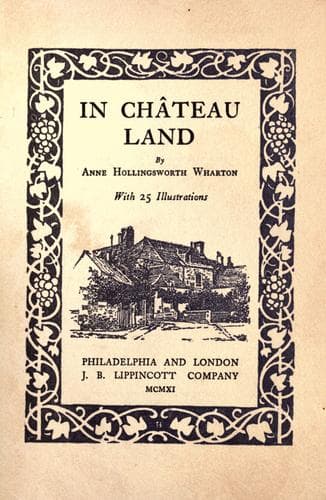
Castles -- France; Touraine (France) -- Description and travel
Again we echo the sentiments of Maitre Francois, and saying "There is
nothing so dear and precious as time," rejoice in this one long, golden
day in Angers. I am writing after our second _dejeuner_. We have all
spent the morning in the most strenuous sightseeing, going to the
cathedral first, which is quite near, its apse blocking the street on
which the Cheval Blanc stands. From the west front of the cathedral,
which is very narrow in proportion to its height, the ground suddenly
descends to the river, a long, broad flight of steps taking the place of
a street. There are, on the facade, some fine carvings of armed
warriors; but the side walls are flat and plain, solid masonry replacing
the flying buttresses which lighten most of the French churches. This
last feature we find to be characteristic of Angevin churches, as are
two other characteristics which impressed us as we entered the
cathedral. One of these is the absence of aisles in the nave, and a
consequent sense of light and spaciousness; the other, the small
dome-like roof into which the vaulting of each section of the nave
rises. There are some curious old tapestries hung on the walls of the
nave, a handsome carved pulpit and some fine glass of the twelfth and
thirteenth centuries. In the chapel to the left is a Calvary by David
d'Angers, a sculptor not without honor in his native town. The chief
object of interest in the cathedral is the tomb of King Rene and his
wife, which was discovered beneath the choir only about fifteen years
ago.
On our way to the chateau, on a broad open space at the intersection of
two boulevards and in the midst of a treeless expanse, stands a statue
of the mild, poetic sovereign of Anjou by David d'Angers. This bronze
statue is on a high, light-colored stone foundation, and shows him no
more kingly and rather less amiable than history, which has always
surrounded Rene d'Anjou with the sympathetic charm that belongs to a
king in exile. Around the base of the monument are smaller statues
representing such founders and leaders of his house as Dumnacus,
defender of the Angevins, Foulques Nera, Robert the Strong and Henry
Plantagenet. Here also are statues of Rene's two wives, Isabelle de
Lorraine and Jeanne de Laval, and of his daughter Margaret, Queen of
England. This monument naturally carried our thoughts back to the days
when the valor of Anjou's counts, and their connection with the thrones
of England and Sicily, gave this land an importance far beyond its
natural value.
Public-domain text, read in full here on John Shaqi.
Reviews
Reviews
No reviews yet
Be the first to share your thoughts on this work.
Elsewhere in the archive
Join the Discussion
Join the discussion
Sign in to leave a comment or review.
Sign InorCreate an account