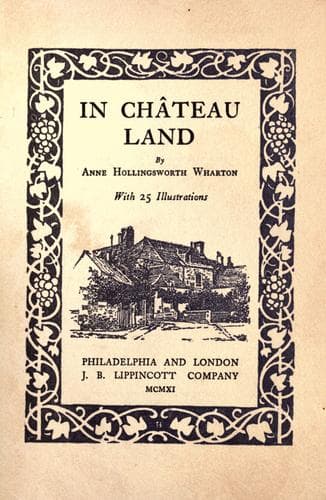
Castles -- France; Touraine (France) -- Description and travel
After this ancient mausoleum, that of Louis and Anne de Bretagne seemed
quite modern, and very handsome, much in the style of the Visconti
monument at the Certosa near Pavia. Not far from this tomb we came upon
that of Henry II and Catherine de Medicis, in which they are represented
in that gruesome fashion so frequent in English cathedral tombs,--the
nude figures below, while above in a beautiful chapel, with marble
columns and pillars, there are handsome bronze figures of the King and
Queen devoutly kneeling. Very inappropriately at the four corners are
placed bronze figures of Faith, Hope, Charity and Good Works. Catherine
is said to have planned this mausoleum herself, and, strange to relate,
in the choir we found another monument to the same King and Queen.
"Just like the grasping creature to want two tombs!" exclaimed Miss
Cassandra. "Most people are satisfied with one."
It appears that in her old age Catherine disapproved of the nude figures
on the first monument, and had this one made with two decently robed
effigies, in marble, resting upon a bronze couch.
We went down into the crypt, all of us except Angela, who still has an
aversion to underground resorts. Ian went with us; but after a hurried
glance at the most important tombs he made his way back to the sunshine
and to Angela. The rest of the party went through everything quite
resolutely, although we found this ancient crypt of the good Abbe Suger
even more gruesome than most crypts. The guide directed us to a tiny
window, through which we could see the place where poor Marie Antoinette
and Louis XVI were finally buried, at least all that could be found of
their remains. Here a light was burning, which they told us was never
allowed to go out. In strange contrast to this solemn little chapel,
there is a kneeling figure of the Queen on one side of the crypt in a
ball dress with jewels around her neck. This statue, by Petitot,
although strangely inappropriate in costume, is beautiful in expression,
and in the modelling of the face, arms, and hands, the latter being very
lovely.
Here also is a "Caveau Imperial," constructed by the order of Napoleon
III, as the burial place of his dynasty. This tomb is quite untenanted,
of course, as no Bonapartes lie at St. Denis; although the bones of the
Valois, Orleans and Bourbon families, who have come and gone in France,
probably forever, are royally entombed here, from their early sovereigns
down to Louis XVIII.
I tell you all this because I think you have not been to St. Denis, and
we found it so much more interesting than we had expected. Walter and
Archie made their acknowledgments to Lydia, in due form, and indeed we
should never have made this pilgrimage had she not been enterprising
enough to lead us forth toward St. Denis and its royal tombs.
September 17th.
Public-domain text, read in full here on John Shaqi.
Reviews
Reviews
No reviews yet
Be the first to share your thoughts on this work.
Elsewhere in the archive
Join the Discussion
Join the discussion
Sign in to leave a comment or review.
Sign InorCreate an account