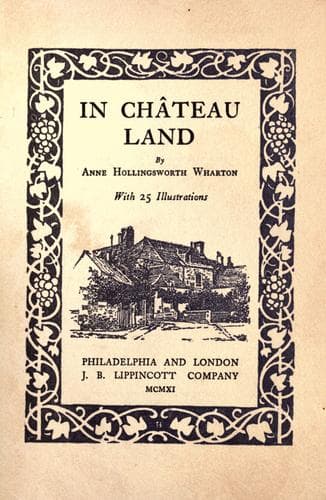
Castles -- France; Touraine (France) -- Description and travel
"By ousting Ludovico, and his lovely wife, Beatrice, who was really far
too good for him; but then most of the women were too good for their
husbands in those days," said Miss Cassandra.
"Fortunately," said M. La Tour, "the Duchess of Milan had died two years
before Ludovico's capture and so was spared the misery of knowing that
her husband was a prisoner in France."
We were glad to emerge from the dismal dungeons into the light and air
by stepping out upon a terrace, from which we had a fine view of the
chateau and the Collegiate Church of St. Ours adjoining it.
The Chateau of Loches, once a fortress guarding the Roman highway, later
belonged to the house of Anjou and was for some years handed about by
French and English owners. As might have been expected, this fortress
was given away by John Lackland (whose name sounds very odd, done into
French, as Jean-Sans-Terre), but was regained by his brother, Richard
Coeur de Lion. It was finally sold to St. Louis, and the chateau,
begun by Charles VII, was completed by Louis XII.
The tower of Agnes Sorel, with its garden terrace, is the most charming
part of the chateau, crowning, as it does, a great rock on the south
side which overlooks the town.
Charles seems to have met the enchanting Agnes while at Loches, whither
she had come in the train of the Countess of Anjou, whose mission to
France was to gain the liberty of her husband, King Rene, who had been
taken prisoner in battle, and was confined in the Tour de Bar, which we
saw at Dijon.
From all accounts Agnes appears to have been a creature of ravishing
beauty and great charm, as the ancient chroniclers describe her with a
complexion of lilies and roses, a mouth formed by the graces, brilliant
eyes, whose vivacity was tempered by an expression of winning sweetness,
and a tall and graceful form. In addition to her personal attraction,
this "Dame de Beaulte" seems to have had a sweet temper, a ready wit,
and judgment far beyond that of her royal lover. According to many
historians, Agnes was the good angel of the King's life, as Joan, the
inspired Maid, had been in a still darker period of his reign. Brantome
relates a story of the favorite's clever and ingenious method of rousing
Charles from his apathy and selfish pursuit of pleasure while the
English, under the Duke of Bedford, were ravaging his kingdom. "It had
been foretold in her childhood, by an astrologer," said Agnes, "that she
should be beloved by one of the bravest and most valiant kings in
Christendom," adding, with fine sarcasm, "that when Charles had paid her
the compliment of loving her she believed him to be, in truth, this
valorous king of whom she had heard, but now seeing him so indifferent
to his duty in resisting King Henry, who was capturing so many towns
under his very nose, she realized that she was deceived and that this
valorous king must be the English sovereign, whom she had better seek,
as he evidently was the one meant by the astrologer."
Public-domain text, read in full here on John Shaqi.
Reviews
Reviews
No reviews yet
Be the first to share your thoughts on this work.
Elsewhere in the archive
Join the Discussion
Join the discussion
Sign in to leave a comment or review.
Sign InorCreate an account