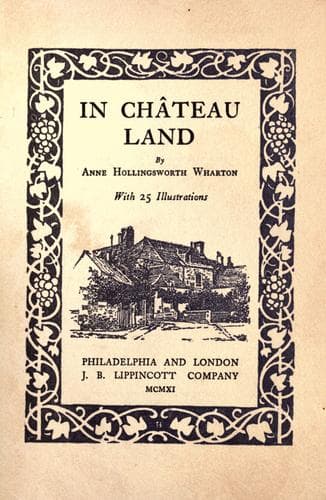
Castles -- France; Touraine (France) -- Description and travel
Matrimonial infelicities are so thickly dotted over the pages of French
history that it is impossible to pause in our excursions through these
palaces to weep over the sorrows of noble ladies. Indeed, for a French
king to have had any affection for his lawful wife seems to have been so
exceptional that it was much more commented upon than the unhappiness of
royal marriages. These reflections are Miss Cassandra's, not mine; and
she added, "I am sorry, though, that Anne's daughter was not happy in
her marriage," in very much the same tone that she would have commented
upon the marriage of a neighbor's daughter. "I hope the beautiful garden
that we have been hearing about was a comfort to her, and there must be
some satisfaction, after all, in being a queen and living in a palace as
handsome as this." With this extremely worldly remark on the part of our
Quaker lady, we passed into the picture gallery of the chateau, where we
saw a number of interesting portraits, among them those of Louis XIII
and of his son Louis XIV, in their childhood, quaint little figures with
rich gowns reaching to their feet, and with sweet, baby faces of
indescribable charm. Here also is a superb portrait of Gaston, the
brother of Louis XIII, and a portrait bust of Madame de Sevigne, whose
charming face seems to belong to Blois, although she has said little
about this chateau in her letters. Here also are portraits of Madame de
Pompadour, Vigee Lebrun, as beautiful as any of the court beauties whom
she painted, and a charming head of Mademoiselle de Blois, the daughter
of Louise de La Valliere, whom Madame de Sevigne called "the good little
princess who is so tender and so pretty that one could eat her." This
was at the time of her marriage, which Louis XIV arranged with the
Prince de Conti, having always some conscience with regard to his
numerous and somewhat heterogeneous progeny.
And in this far off gallery of France our patriotism was suddenly
aroused to Fourth of July temperature by seeing a portrait of
Washington. This portrait, by Peale or Trumbull, was doubtless presented
to one of the French officers who were with Washington in many of his
campaigns, and the strong calm face seemed, in a way, to dominate these
gay and gorgeously appareled French people, as in life he dominated
every circle that he entered.
We were especially interested in a bust of Ronsard with his emblem of
three fishes, which delighted Walter and Archie, who now propose a
fishing trip to his Chateau of La Poissonniere. We love Ronsard for many
of his verses, above all for the lines in which he reveals his feeling
for the beauties of nature, which was rare in those artificial days. Do
you remember what he said about having a tree planted over his grave?
"Give me no marble cold
When I am dead,
But o'er my lowly bed
May a tree its green leaves unfold."
XI
THE ROMANCE OF BLOIS
Public-domain text, read in full here on John Shaqi.
Reviews
Reviews
No reviews yet
Be the first to share your thoughts on this work.
Elsewhere in the archive
Join the Discussion
Join the discussion
Sign in to leave a comment or review.
Sign InorCreate an account