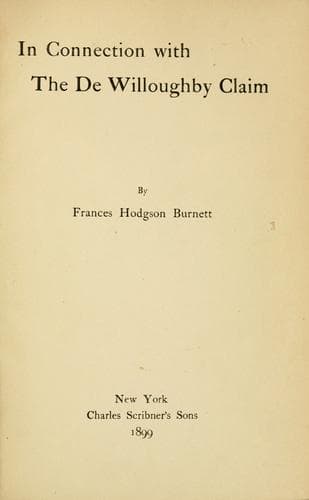
In Connection with the De Willoughby ClaimBurnett, Frances Hodgson
General
In Connection with the De Willoughby Claim
Burnett, Frances Hodgson
United States -- Social life and customs -- 19th century -- Fiction
When she was able to stand on her feet she went back to the mill. She was
a good worker, and hands were needed. The girls and women fought shy of
her, and she had no chance of enjoying any young pleasures or comforts,
even if she had not been too much broken on the rack of the misery of the
last year to have energy to desire them. No young man wanted to be seen
talking to her, no young woman cared to walk with her in the streets. She
always went home to her room alone, and sat alone, and thought of what
had happened to her, trying to explain to herself how it had happened and
why it had turned out that she was worse than any other girl. She had
never felt like a bad girl. No one had ever called her one before this
last year.
Three months after the child was born and died, Margery came back to
Willowfield to spend a week at home. She came to see Susan, and they sat
together in the tragic little bare room and talked. Though the girl had
been so delicately pretty before she left home, Susan saw that she had
become much prettier. She was dressed in light, softly tinted summer
stuffs, and there was something about her which was curiously
flower-like. Her long-lashed, harebell blue eyes seemed to have widened
and grown lovelier in their innocent look. A more subtle mind than Susan
Chapman's might have said that she seemed to be looking farther into
Life's spaces, and that she was trembling upon the verge of something
unknown and beautiful.
She talked about Boston and the happiness of her life there, and of her
work and her guileless girlish hopes and ambitions.
"I am doing my very best," she said, a spot of pink flickering on her
cheek; "I work as hard as I can, but you see I am so ignorant. I could
not have learned anything about art in Willowfield. But people are so
good to me--people who know a great deal. There is one gentleman who
comes sometimes to see Mr. Barnard at the studio. He is so wonderful, it
seems to me. He has travelled, and knows all about the great galleries
and the pictures in them. He talks so beautifully that everyone listens
when he comes in. Nobody can bear to go on with work for fear of missing
something. You would think he would not notice a plain little Willowfield
girl, but he has been _lovely_ to me, Susan. He has even looked at my
work and criticised it for me, and talked to me. He nearly always talks
to me a little when he comes in, and once I met him in the Gardens, and
he stopped and talked there, and walked about looking at the flowers with
me. They had been planting out the spring things, and it was like being
in fairyland to walk about among them and hear the things he said about
pictures. It taught me so much."
Public-domain text, read in full here on John Shaqi.
Reviews
Reviews
No reviews yet
Be the first to share your thoughts on this work.
Elsewhere in the archive
Join the Discussion
Join the discussion
Sign in to leave a comment or review.
Sign InorCreate an account