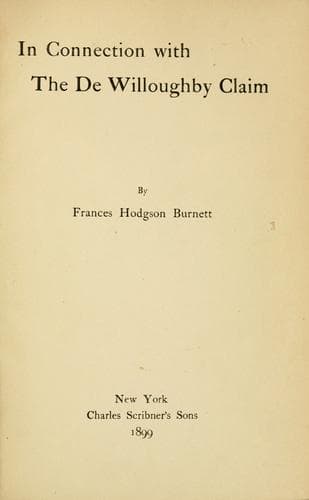
In Connection with the De Willoughby ClaimBurnett, Frances Hodgson
General
In Connection with the De Willoughby Claim
Burnett, Frances Hodgson
United States -- Social life and customs -- 19th century -- Fiction
The girl wiped her eyes and added, slowly, almost as if she was thinking
aloud:
"I'm not one of the strong ones--I'm not one of the strong ones--no more
than little Margery was."
She said the last words with a kind of unconscious consciousness. While
she uttered them her mind had evidently turned back to other times--not
her own, but little Margery's.
Miss Amory drew a deep breath. She took up her knitting. She asked a
question.
"You knew her very well--Margery?"
Susan drew her chair closer and looked in the old face with uncertain
eyes.
"Miss Starkweather," she said, "do you think that a girl's being--like
me--would make her evil-minded? Would it make her suspicion things, and
be afraid of them--when there wasn't nothin'? I should think that it
would," quite wistfully.
"It might," answered Miss Amory, her knitting-needles flying; "but for
God's sake don't call yourself evil-minded. You'd be evil-minded if you
were _glad_ to suspect--not if you were sorry and afraid."
"Glad!" with a groan. "Oh, Lord, I guess not. But I might be all wrong
all the same, mightn't I?"
"Yes, you might."
"I loved her--oh, Lord, I did love her! I'd reason to," the girl went on,
and her manner had the effect of frightened haste. "I've suffered awful
sometimes--thinkin' in the night and prayin' there wasn't nothin'. She
was such a delicate, innocent little thing. It would have killed her."
"What were you afraid of?"
"Oh, I don't know," Susan answered, hysterically. "I don't. I only knew
she couldn't bear nothin' like--like lyin' awake nights gaspin' an'
fightin' with awful fear. She couldn't--she couldn't."
"But there are girls--women, who have to bear it," said Miss Amory. "Good
God, who _have_ to!"
"Yes--yes--yes," cried Susan. She drew her hand across her brow as if
suddenly it felt damp, and for a moment her eyes looked wild with a
memory of some awful thing. "I told her so," she said.
Miss Amory Starkweather turned in her chair with something like a start.
"You told her so," she exclaimed.
Susan stared out of the window and her voice fell.
"I didn't go to," she answered. "It was like this. That last time she
came to see me--to tell me how ill she was and how Lucien was going to
take her away--I'd been lookin' at the little clothes I'd got ready
for--it." The tears began to roll fast down her cheeks. "Oh, Miss
Starkweather! they was lyin' on the bed--an' she saw 'em an' turned as
white as a sheet."
"Ugh!" the sound broke from Miss Amory like a short, involuntary groan.
"She said she didn't know how people could _bear_ it," Susan hurried on,
"an' I said--just like you did--that they _had_ to bear it."
She suddenly hid her face in her arms.
"You were thinking of yourself," said Miss Amory. She felt and looked a
little sick.
Public-domain text, read in full here on John Shaqi.
Reviews
Reviews
No reviews yet
Be the first to share your thoughts on this work.
Elsewhere in the archive
Join the Discussion
Join the discussion
Sign in to leave a comment or review.
Sign InorCreate an account