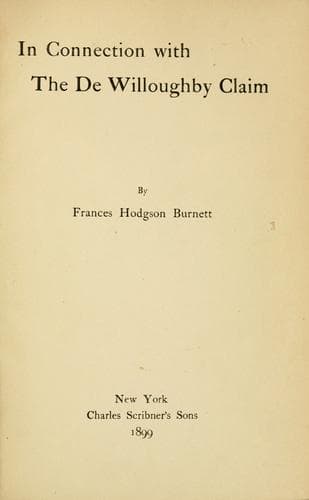
In Connection with the De Willoughby ClaimBurnett, Frances Hodgson
General
In Connection with the De Willoughby Claim
Burnett, Frances Hodgson
United States -- Social life and customs -- 19th century -- Fiction
"'Twarn't Jedge D'Willerby bought the land," he went on to explain, "'n'
it seems like he would hev bin a fool to hev done it, bein' as 'tain't
worked an' brings in nothin'. But ye never know how things may turn out.
'Twas the Jedge's gran'father, old Isham D'Willerby bought it fer a
kinder joke. Some said he was blind drunk when he done it, but he warn't
so drunk but what he got a cl'ar title, an' he got it mighty cheap too.
Folks ses as he use ter laugh an' say he war goin' to find gold on it,
but he never dug fer none--nor fer crops nuther, an' thar it lies to-day
in the mountains, an' no one goin' nigh it."
In truth, Judge De Willoughby merely paid his taxes upon it from a sense
of patriarchal pride.
"My ancestor bought it," he would say. "I will hand it to my sons. In
England it would be an estate for an earldom, here it means merely
tax-paying. Still, I shall not sell it."
Nobody, in fact, would have been inclined to buy it in those days. But
there came a time when its value increased hour by hour in the public
mind, until it was almost beyond computation.
A chance visitor from the outside world made an interesting discovery. On
this wild tract of hill and forest was a vein of coal so valuable that,
to the practical mind of the discoverer, the Judge's unconsciousness of
its existence was amazing. He himself was a practical, driving, business
schemer from New York. He knew the value of what he saw, and the
availability of the material in consequence of a certain position in
which the mines lay. Before he left Delisleville he had explained this
with such a presenting of facts that the Judge had awakened to an
enthusiasm as Southern as his previous indifference had been. He had no
knowledge of business methods; he had practised his profession in a
magnificent _dilettante_ sort of way which had worn an imposing air and
impressed his clients, and, as he was by inheritance a comparatively rich
man, he had not been driven by necessity to alter his methods. The sudden
prospect of becoming a multimillionaire excited him. He made Napoleonic
plans, and was dignified and eloquent.
"Why should I form a company?" he said. "If I am willing to make the
first ventures myself, the inevitable returns of profit will do the rest,
and there will be no complications. The De Willoughby Mine will be the De
Willoughby Mine alone. I prefer that it should be so."
Public-domain text, read in full here on John Shaqi.
Reviews
Reviews
No reviews yet
Be the first to share your thoughts on this work.
Elsewhere in the archive
Join the Discussion
Join the discussion
Sign in to leave a comment or review.
Sign InorCreate an account