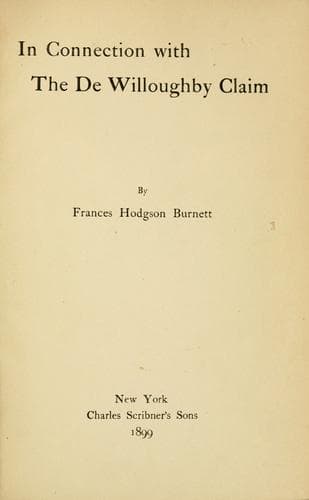
In Connection with the De Willoughby ClaimBurnett, Frances Hodgson
General
In Connection with the De Willoughby Claim
Burnett, Frances Hodgson
United States -- Social life and customs -- 19th century -- Fiction
The big, empty-sounding house was kept orderly and spotless, the back
garden exhibited such vegetables as no one else owned, the fruit-trees
and grape-vines throve, in time the flower-beds began to bloom
brilliantly, the rose-bushes and shrubs were trimmed, the paths swept,
and people began to apply to Uncle Matt for slips and seeds. He himself
became quite young again, so inspired was he by his importance and
popularity. When he went into the town upon errands, people stopped to
talk to him; the young business or professional men called him into their
offices to have a chat with him. He was such a respectable relic of the
times which had been "better days" to all of them, that there were those
who were almost confidential with him. Uncle Matt would always understand
their sentiments and doctrines, and he was always to be relied on for any
small service. Such a cocktail or julep no one else could prepare, and
there were numerous subtle accomplishments in the matter of mixing liquid
refreshments which would have earned a reputation for any man.
There was no more familiar figure than his in the market or business
streets of the hot, sunshine-flooded little town, which the passing
armies had left so battered and deserted.
Uncle Matt knew all the stories in Delisleville. He knew how one house
was falling to pieces for lack of repairs; he heard of the horses that
had been sold or had died of old age and left their owners without a
beast to draw their rickety buggies or carriages; he was deeply
interested in the failing fortunes of what had once been the most
important "store" in the town, and whose owner had been an aristocratic
magnate, having no more undignified connection with the place than that
of provider of capital.
As he walked up Main Street on his way to market, with his basket on his
arm, he saw who had been able to "lay in new stock" and who had not. He
saw the new sign-boards hung outside small houses which had been turned
into offices. He knew what young scion of a respectable family had begun
"doctoring" or "set up as a lawyer." Sometimes he even dropped in and
made brief visits of respectful congratulation.
"But," he said privately to his young master, "de air ob de atmosphere,
it's jest full of dem young lawyers an' doctors. Dar don't seem to be
nothin' else for a gen'leman's sons to do but to kyore people or go to
law for 'em. Of cose dey oughtn't ter hab ter work, gen'lemen oughtn'ter.
Dey didn't usen to heb ter, but now dey is gotter. Lawdy, Marse Rupert,
you'll hatter 'scuse me, but de young lawyers, an' de young doctors, dey
is scattered about dish yer D'lisleville!"
There were certain new sign-boards which excited him to great interest.
There was one he never passed without pausing to examine and reflect upon
it.
Public-domain text, read in full here on John Shaqi.
Reviews
Reviews
No reviews yet
Be the first to share your thoughts on this work.
Elsewhere in the archive
Join the Discussion
Join the discussion
Sign in to leave a comment or review.
Sign InorCreate an account