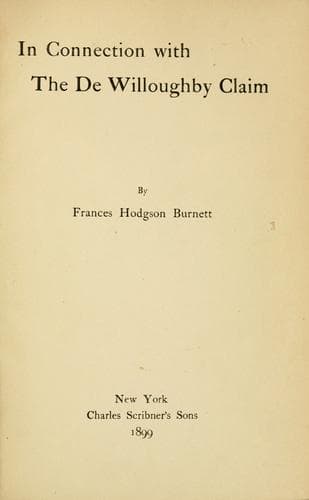
In Connection with the De Willoughby ClaimBurnett, Frances Hodgson
General
In Connection with the De Willoughby Claim
Burnett, Frances Hodgson
United States -- Social life and customs -- 19th century -- Fiction
"Now thar's D'Willerby," he went on. "Big Tom--Tom D'Willerby lost
enough, the Lord knows. Fust one army, 'n' then another layin' holt on
his stock as it come over the road from one place an' another, a-eatin'
of it up 'n' a-wearin' his goods made up into shirts 'n' the like-'n' him
left a'most cleaned out o' everythin'. Why, Tom D'Willerby----"
"'Scuse me, sah," interrupted Matt, "but did you say De Willoughby?"
"I said D'Willerby," answered Mr. Stamps. "That's what he's called at the
Cross-roads."
There he stopped and stared at Matt a moment.
"My young master's name's De Willoughby, sah," Matt said; "'n' de names
soun's mighty simulious when dey's spoke quick. My young Marse, Rupert De
Willoughby, he de gran'son er Jedge De Willoughby, an' de son an' heir er
Cun'l De Courcy De Willoughby what died er yaller fever at Nashville."
"Well, I'm doggoned," the little man remarked, "I'd orter thought er
thet. This yere's Delisleville, 'n' I reckerlect hearin' when fust he
come to Hamlin thet he was some kin to some big bugs down ter
D'lisleville, 'n' his father was a Jedge--doggoned ef I didn't!"
CHAPTER XIX
Rupert De Willoughby was lying upon the grass in the garden under the
shade of a tree. The "office" had been stifling hot, and there had been
even less to suggest any hope of possible professional business than the
blankness of most days held. There never was any business, but at rare
intervals someone dropped in and asked him a question or so, his answers
to which, by the exercise of imagination, might be regarded as coming
under the head of "advice." His clients had no money, however--nobody had
any money; and his affairs were assuming a rather desperate aspect.
He had come home through the hot streets with his straw hat pushed back,
the moist rings of his black hair lying on a forehead lined with a rather
dark frown. He went into the garden and threw himself on the grass in the
shade. He could be physically at ease there, at least. The old garden had
always been a pleasure to him, and on a hot summer day it was full of
sweet scents and sounds he was fond of. At this time there were tangles
of honeysuckle and bushes heavy with mock-orange; an arbour near him was
covered by a multiflora rose, weighted with masses of its small, delicate
blossoms; within a few feet of it a bed of mignonette grew, and the
sun-warmed breathing of all these fragrant things was a luxurious
accompaniment to the booming of the bees, blundering and buzzing in and
out of their flowers, and the summer languid notes of the stray birds
which lit on the branches and called to each other among the thick
leaves.
Public-domain text, read in full here on John Shaqi.
Reviews
Reviews
No reviews yet
Be the first to share your thoughts on this work.
Elsewhere in the archive
Join the Discussion
Join the discussion
Sign in to leave a comment or review.
Sign InorCreate an account