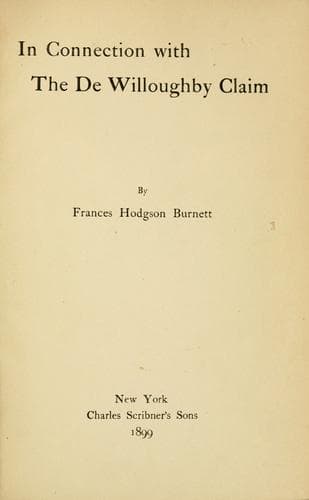
In Connection with the De Willoughby ClaimBurnett, Frances Hodgson
General
In Connection with the De Willoughby Claim
Burnett, Frances Hodgson
United States -- Social life and customs -- 19th century -- Fiction
trees, making little darts of joy at the brown, glossy things bursting
through their big burrs, was a delicious, exciting thing. Mornin's hot
breakfast held keen delights when they returned to it.
When the big wood-fires were lighted and there was snow and rain outside,
and yams and chestnuts to roast in the ashes, and stories to be told and
talked over in the glow of the red birch-log and snapping, flaming
hickory sticks, the child used to feel as if she and Uncle Tom were even
nearer together and more comfortable than at any other time.
"Uncle Tom," she said to him, as she was standing in the circle of his
arm on one such night, when she was about ten years old. "Uncle Tom, we
do love each other in the winter, don't we?"
"Yes, we do, Sheba," answered Tom. "And we're pretty partial to each
other even in the summer."
"We love each other at all the times," she said. "And every morning that
I get up I love you more than I did when I went to bed--_every_ morning,
Uncle Tom."
Tom kissed her. He remembered what he had said one morning in the cabin
in Blair's Hollow ten years before.
"Perhaps, if there's no one to come between us, she may be fond of me."
She was fond of him. He was her very little life itself. No one had ever
come between--nothing ever could.
She had by that time shot up into a tall, slender slip of a girl-child.
She was passing, even with a kind of distinction, through the stage of
being all long, slim legs and big eyes. The slim legs were delicately
modelled and the big eyes were like pools of gold-brown water, fringed
with rushes.
"I never seen a young 'un at thet thar young colty age es was es han'some
es thet child o' Big Tom's," Mis' Doty often remarked.
By the frequenters of the Cross-roads Post-office she was considered, as
was her protector, a county institution. When she had reached three years
old, she had been measured against the wall, and each year her increase
of inches was recorded amid lively demonstrations of interest. The
smallness of her feet had also been registered, and the thickness and
growth of her curling hair ranked as a subject of discussion only second
in interest to the development of crops.
But this affection notwithstanding, a curious respect for her existed.
She had played among them in the store in her little dusty pinafore; one
and all of them had given her rustic offerings, bringing her special
gifts of yellow popcorn ears, or abnormal yams unexpectedly developed in
their own gardens, or bags of hickory nuts; but somehow they did not
think or speak of her as they did of each other's children.
Public-domain text, read in full here on John Shaqi.
Reviews
Reviews
No reviews yet
Be the first to share your thoughts on this work.
Elsewhere in the archive
Join the Discussion
Join the discussion
Sign in to leave a comment or review.
Sign InorCreate an account