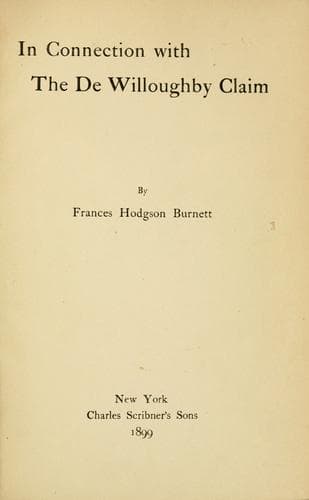
In Connection with the De Willoughby ClaimBurnett, Frances Hodgson
General
In Connection with the De Willoughby Claim
Burnett, Frances Hodgson
United States -- Social life and customs -- 19th century -- Fiction
She was not sent to Ralston. The war broke out and altered the aspect of
things even at the Cross-roads. The bank in which Tom's modest savings
were deposited was swept away by misfortune; the primitive resources of
Hamlin County were depleted, as the resources of all the land were. But
for the existence of the white, vine-embowered house and the garden full
of scents and bloom, Tom's position at the close of the rebellion was far
less fortunate than it had been at the time the mystery of Blair's Hollow
had occurred. In those old, happy-go-lucky days the three rooms behind
the store and the three meals Mornin cooked for him had been quite
sufficient for free and easy peace. He had been able to ensure himself
these primitive comforts with so little expenditure that money had
scarcely seemed an object. He had taken eggs in exchange for sugar, bacon
in exchange for tea, and butter in exchange for everything. Now he had no
means of resource but the store, and the people were poorer than they had
been. Farms had gone to temporary ruin through unavoidable neglect during
the absence of their masters. More than one honest fellow had marched
away and never returned, and their widows were left to struggle with the
land and their children. The Cross-roads store, which had thriven so
wonderfully for a year or two before the breaking out of the war, began
to wear a less cheerful aspect. As far as he himself was concerned, Tom
knew that life was a simple enough thing, but by his side there was
growing up a young goddess. She was not aware that she was a young
goddess. There was no one in the vicinity of the Cross-roads who could
have informed her that she presented somewhat of that aspect, and that
she was youth and happiness and Nature's self at once.
Tom continually indulged in deep reflection on his charge after she was
twelve years old. She shot up into the tall suppleness of a lovely young
birch, and she was a sweetly glowing thing. A baby had been a different
matter; the baby had not been so difficult to manage; but when he found
himself day by day confronting the sweetness of child-womanhood in the
eyes that were gold-brown pools, and the softening grace of the fair
young body, he began to be conscious of something like alarm. He was not
at all sure what he ought to do at this crisis, and whether life
confining its experiences entirely to Talbot's Cross-roads was all that
was required.
"I don't know whether it's right, by thunder," he said. "I don't know
whether it's right; and that's what a man who's taken the place of a
young mother ought to know."
There came a Sunday when one of the occasional "preachings" was to be
held at the log-cabin church a few miles distant, and they were going
together, as they always did.
Public-domain text, read in full here on John Shaqi.
Reviews
Reviews
No reviews yet
Be the first to share your thoughts on this work.
Elsewhere in the archive
Join the Discussion
Join the discussion
Sign in to leave a comment or review.
Sign InorCreate an account