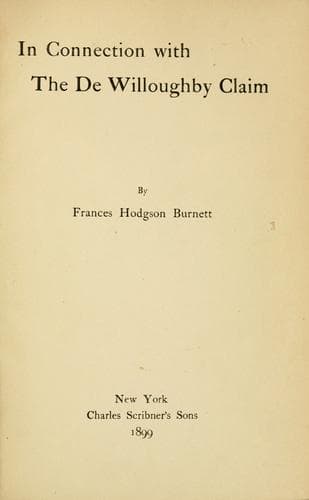
In Connection with the De Willoughby ClaimBurnett, Frances Hodgson
General
In Connection with the De Willoughby Claim
Burnett, Frances Hodgson
United States -- Social life and customs -- 19th century -- Fiction
"No," he answered, laughing; "it delights me. No one ever wanted to look
at me before. But I should hardly think they would want to look at me
when they might look at you instead."
"They have looked at me for eighteen years," she answered. "They looked
at me when I had the measles, and saw me turn purple when I had the
whooping-cough."
As they were going away, they passed a little man who had just arrived
and was hitching to the horse-rail a raw-boned "clay-bank" mare. He
looked up as they neared him and smiled peacefully.
"Howdy?" he said to Rupert. "Ye hain't seen me afore, but I seen you when
I was to Delisleville. It wuz me as told yer nigger ye'd be a fool if ye
didn't get Tom ter help yer to look up thet thar claim. Ye showed horse
sense by comin'. Wish ye luck."
"Uncle Tom," said Sheba, as they sat at their dinner and Mornin walked
backwards and forwards from the kitchen stove to the dining-room with
chicken fried in cream, hot biscuits, and baked yams, "we saw Mr. Stamps
and he wished us luck."
"He has a claim himself, hasn't he?" said Rupert. "He told Matt it was
for a yoke of oxen."
Tom broke into a melodious roar of laughter.
"Well," he said, "if we can do as well by ours as Stamps will do by his,
we shall be in luck. That yoke of oxen has grown from a small beginning.
If it thrives as it goes on, the Government's in for a big thing."
"It has grown from a calf," said Sheba, "and it wasn't six weeks old."
"A Government mule kicked it and broke its leg," said Tom. "Stamps made
veal of it, and in two months it was 'Thet heifer o' mine'--in six months
it was a young steer----"
"Now it's a yoke of oxen," said Rupert; "and they were the pride of the
county."
"Lord! Lord!" said Tom, "the United States has got something to
engineer."
CHAPTER XXIII
It was doubtless Stamps who explained the value of the De Willoughby
claim to the Cross-roads. Excited interest in it mounted to fever heat in
a few days. The hitching rail was put to such active use that the horses
shouldered each other and occasionally bit and kicked and enlivened the
air with squeals. No one who had an opportunity neglected to appear at
the post-office, that he or she might hear the news. Judge De
Willoughby's wealth and possessions increased each time they were
mentioned. The old De Willoughby place became a sort of princely domain,
the good looks of the Judge's sons and daughters and the splendour of
their gifts were spoken of almost with bated breath. The coal mines
became gold mines, the money invested in them something scarcely to be
calculated. The Government at Washington, it was even inferred, had not
money enough in its treasury to refund what had been lost and indemnify
for the injury done.
"And to think o' Tom settin' gassin' yere with us fellers," they said,
admiringly, "jest same es if he warn't nothin'. A-settin' in his shirt
sleeves an' tradin' fer eggs an' butter. Why, ef he puts thet thar claim
through, he kin buy up Hamlin."
Public-domain text, read in full here on John Shaqi.
Reviews
Reviews
No reviews yet
Be the first to share your thoughts on this work.
Elsewhere in the archive
Join the Discussion
Join the discussion
Sign in to leave a comment or review.
Sign InorCreate an account