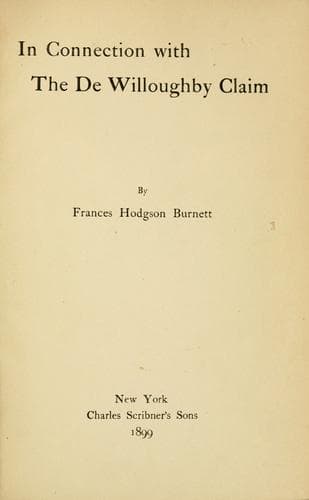
In Connection with the De Willoughby ClaimBurnett, Frances Hodgson
General
In Connection with the De Willoughby Claim
Burnett, Frances Hodgson
United States -- Social life and customs -- 19th century -- Fiction
The Judge went home to his boarding-house and sat late in his shabby
armchair, his legs stretched out, his hands clasped on the top of his
rough head. He was thinking the thing out, and as he thought it out his
excitement grew. Sometimes he unclasped his hands and rubbed his hair
with restless sigh; more than once he unconsciously sprang to his feet,
walked across the floor two or three times, and then sat down again. He
was not a sharp schemer, he had not even reached the stage of
sophistication which would have suggested to him that sharp scheming
might be a necessary adjunct in the engineering of such matters as
Government claims. From any power or tendency to diplomatise he was as
free as the illustrative bull in a china shop. His bucolic trust in the
simple justice and honest disinterestedness of the political
representatives of his native land (it being granted they were of the
Republican party) might have appeared a touching thing to a more astute
and experienced person who had realised it to its limits. When he rubbed
his hair excitedly or sprang up to walk about, these manifestations were
indications, not of doubt or distrust, but of elated motion. It was the
emotional aspect of the situation which delighted and disturbed him, the
dramatic picturesqueness of it. Here was Tom--good old Tom--all Hamlin
knew Tom and his virtues and witticisms--Lord! there wasn't a man in the
county who didn't love him--yes, _love_ him. And here was Sheba that Tom
had been a father to. And what a handsome little creature she'd grown
into--and, but for Tom, the Lord knew what would have become of her. And
there was that story of the De Willoughbys of Delisleville--handsome,
aristocratic lot, among the biggest bugs in the State--the fine old Judge
with his thousands of acres lying uncultivated, and he paying his taxes
on them through sheer patriarchal pleasure in being a big landowner. For
years the Government had benefited by his tax-paying, while he had gained
nothing. And then there was the accidental discovery of the splendid
wealth hidden in the bowels of the earth--and the old aristocrat's energy
and enterprise. Why, if the war had not brought ruin to him and he had
carried out his plans, the whole State would have been the richer for his
mines. Capital would have been drawn in, labour would have been in
demand--things would have developed--outsiders would have bought
land--new discoveries would have been made--the wealth of the country's
resources would have opened up--the Government itself would have
benefited by the thing. And then the war had ruined all. And yet the old
Judge, overwhelmed with disaster as he was, had stood by the Government
and had been scorned and deserted, and had died broken-hearted at the
end, and here were his sole descendants--good old Tom and his little
beauty of a protegee--(no, Sheba wasn't a descendant, but somehow she
counted), and this fine young De Willoughby--all of them penniless. Why,
Public-domain text, read in full here on John Shaqi.
Reviews
Reviews
No reviews yet
Be the first to share your thoughts on this work.
Elsewhere in the archive
Join the Discussion
Join the discussion
Sign in to leave a comment or review.
Sign InorCreate an account