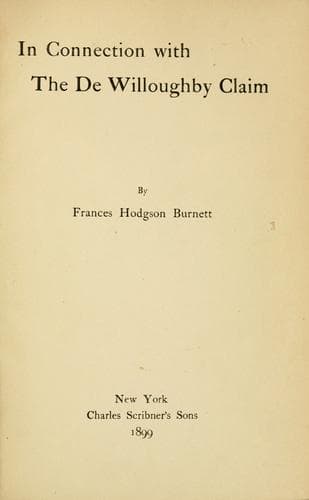
In Connection with the De Willoughby ClaimBurnett, Frances Hodgson
General
In Connection with the De Willoughby Claim
Burnett, Frances Hodgson
United States -- Social life and customs -- 19th century -- Fiction
"I thought too much," he said. "I don't know how it was. But just at that
time there was a miserable story going on at the mills--I used to see the
poor girl day by day--and hear the women talk. You know how that class of
woman talks and gives you details and enlarges on them? The girl was
about Margery's age. I don't know how it was; but one day, as I was
standing listening to a gossipping married woman in one of their squalid,
respectable parlours, and she was declaiming and denouncing and pouring
forth anecdotes, suddenly--quite suddenly--I felt as if something had
struck me. I turned sick and white and had to sit down. Oh, God! what an
afternoon that was! and how long it seemed before I got back home."
He stopped again. This time he wiped sweat from his forehead before he
continued, hoarsely:
"I cannot go over it--I cannot describe the steps by which I was led
to--horrid fear. For two weeks I did not sleep a single night. I thought
I was going mad. I laid awake making desperate plans--to resort to in
case--in case----!"
His forehead was wet again, and he stopped to touch it with his
handkerchief.
"One day I told my mother I was going to Boston to see Margery--to talk
over the possibility of our going abroad together with the money I had
worked for and saved. I had done newspaper work--I had written religious
essays--I had taught. I went to her."
It was Baird who broke the thread of his speech now. He had been standing
before a window, his back to the room. He turned about.
"You found?" he exclaimed, low and unsteady. "You found----?"
"It was true," answered Latimer. "The worst."
Baird stood stock still; if Latimer had been awake to externals he would
have seen that it was because he could not move--or speak. He was like a
man stunned.
Latimer continued:
"She was sitting in her little room alone when I entered it. She looked
as if she had been passing through hours of convulsive sobbing. She sat
with her poor little hands clutching each other on her knees. Hysteric
shudders were shaking her every few seconds, and her eyes were blinded
with weeping. A child who had been beaten brutally might have sat so. She
was too simple and weak to bear the awful terror and woe. She was not
strong enough to conceal what there was to hide. She did not even get up
to greet me, but sat trembling like an aspen leaf."
"What did you say to her?" Baird cried out.
"I only remember as one remembers a nightmare," the other man answered,
passing his hand over his brow. "It was a black nightmare. I saw before I
spoke, and I began to shake as she was shaking. I sat down before her and
took both her hands. I seemed to hear myself saying, 'Margery--Margery,
don't be frightened--don't be afraid of Lucian. I will help you, Margery;
I have come to talk to you--just to talk to you.' That was all. And she
fell upon the floor and lay with her face on my feet, her hands clutching
them."
Public-domain text, read in full here on John Shaqi.
Reviews
Reviews
No reviews yet
Be the first to share your thoughts on this work.
Elsewhere in the archive
Join the Discussion
Join the discussion
Sign in to leave a comment or review.
Sign InorCreate an account