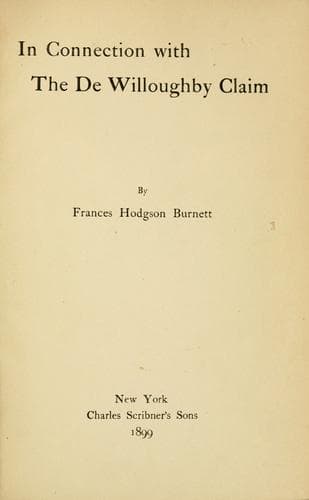
In Connection with the De Willoughby ClaimBurnett, Frances Hodgson
General
In Connection with the De Willoughby Claim
Burnett, Frances Hodgson
United States -- Social life and customs -- 19th century -- Fiction
"We were alone," answered Latimer. "I did not know whom to call. I read
medical books--for hours each day I read them. I thought that perhaps I
might be able to do--what was necessary. But on the night she was taken
ill--I was stricken with terror. She was so young and childlike--she had
lived through months of torture--the agony seemed so unnatural to me,
that I knew I must go for help--that I was not mentally calm enough to go
through the ordeal. A strange chance took me to a man who had years
before studied medicine as a profession. He was a singular being, totally
unlike his fellows. He came to her. She died with her hand in his."
"Did the child die too?" Baird asked, after a pause.
"No; it lived. After she was laid in the earth on the hillside, I came
away. It was the next day, and I was not sane. I had forgotten the child
existed, and had made no plans for it. The man I spoke of--he was
unmarried and lonely, and a strange, huge creature of a splendid
humaneness--he had stood by me through all--a mountain of strength--the
man came to my rescue there and took the child. It would be safe with
him. I know nothing more."
"Do you not know his name?" Baird asked.
"Yes; he was called Dwillerby by the country people. I think he had been
born a gentleman, though he lived as the mountaineers did."
"Afterwards," said Baird, "you went abroad as you had planned?"
"Yes. I invented the story of her death. I wrote the details carefully. I
learned them as a lesson. It has been my mother's comfort--that story of
the last day--the open window--the passing peasants--the setting sun--I
can see it all myself. That is my lie. Did you suspect it when I told
it?"
"No, God knows!" Baird answered. "I did not."
"Never?" inquired Latimer.
"What I have thought was that you had suffered much more than you wished
your mother to know; that--perhaps--your sister had suffered more than
you would reveal; and that you dreaded with all your being the telling of
the story. But never such tragedy as this--never--never!"
"The man--the man who wrought that tragedy," began Latimer, staring
darkly before him, "somewhere he stands to-night--unless his day is done.
Somewhere he stands--as real a man as _you_."
"With all his load upon him," said Baird; "and he may have loved her
passionately."
"It should be a heavy load," said Latimer, with bitter gloom;
"heavy--heavy."
"You have not once uttered his name," said Baird, the thought coming to
him suddenly.
"No," said Latimer; "I never knew it. She prayed so piteously that I
would let her hide it. She knelt and sobbed upon my knee, praying that I
would spare her that one woe. I could spare her no other, so I gave way.
She thanked me, clinging to me and kissing my hand. Ah, her young, young
heart wrung with sobs and tears!"
Public-domain text, read in full here on John Shaqi.
Reviews
Reviews
No reviews yet
Be the first to share your thoughts on this work.
Elsewhere in the archive
Join the Discussion
Join the discussion
Sign in to leave a comment or review.
Sign InorCreate an account