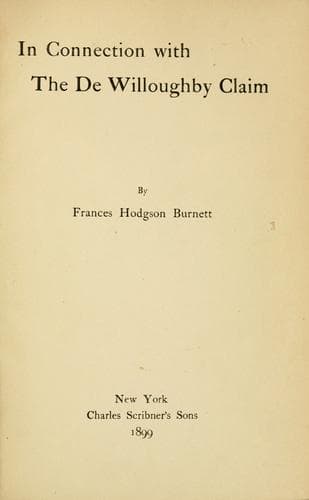
In Connection with the De Willoughby ClaimBurnett, Frances Hodgson
General
In Connection with the De Willoughby Claim
Burnett, Frances Hodgson
United States -- Social life and customs -- 19th century -- Fiction
The Reverend John Baird delivered his lectures in many cities that year.
The discussion they gave rise to had the natural result of awakening a
keen interest in them. There were excellent souls who misinterpreted and
deplored them, there were excellent souls who condemned; there were even
ministers of the gospel who preached against the man as an iconoclast and
a pagan, and forbade their congregations to join his audiences. But his
lecture-halls were always crowded, and the hundreds of faces upturned to
him when he arose upon his platform were the faces of eager, breathless,
yearning creatures. He was a man speaking to men, not an echo of old
creeds. He uttered no threats, he painted no hells, he called aloud to
that God in man which is his soul.
"That God which is in you--in me," he proclaimed, "has lain dormant
because undeveloped man, having made for himself in the dark ages gods of
wood and stone, demanding awful sacrifice, called forth for himself later
a deity as material, though embodied in no physical form--a God of
vengeance and everlasting punishments. This is the man-created deity, and
in his name man has so clamoured that the God which is man's soul has
been silenced. Let this God rise, and He will so demand justice and noble
mercy from all creatures to their fellows that temptation and suffering
will cease. What! can we do no good deed without the promise of paradise
as reward? Can we refrain from no evil unless we are driven to it by the
threat of hell? Are we such base traffickers that we make merchandise of
our souls and bargain for them across a counter? Let us awake! I say to
you from the deepest depths of my aching soul--if there were no God to
bargain with, then all the more awful need that each man constitute
himself a god--of justice, pity, and mercy--until the world's wounds are
healed and each human thing can stand erect and claim the joy of life
which is his own."
On the morning of the day he said these words to the crowd which had
flocked to hear him, he had talked long with Latimer. For some weeks he
had not been strong. The passion of intensity which ruled him when he
spoke to his audiences was too strong an emotion to leave no physical
trace. After a lecture or sermon he was often pallid and shaken.
"I have things to say," he exclaimed feverishly to Latimer. "There are
things which must be said. The spoken word lives--for good or evil. It is
a sound sent echoing through all the ages to come. Some men have awakened
echoes which have thrilled throughout the world. To speak one's
thought--to use mere words--it seems such a small thing--and yet it is my
conviction that nothing which is said is really ever forgotten."
And his face was white, his eyes burning, when at night he leaned forward
to fling forth to his hearers his final arraignment.
Public-domain text, read in full here on John Shaqi.
Reviews
Reviews
No reviews yet
Be the first to share your thoughts on this work.
Elsewhere in the archive
Join the Discussion
Join the discussion
Sign in to leave a comment or review.
Sign InorCreate an account