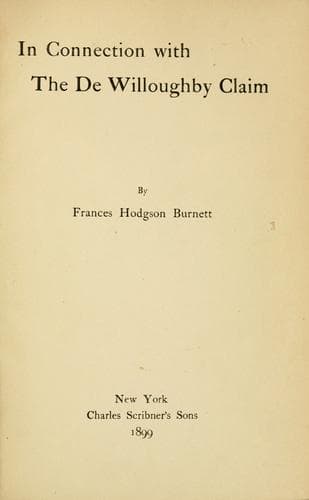
In Connection with the De Willoughby ClaimBurnett, Frances Hodgson
General
In Connection with the De Willoughby Claim
Burnett, Frances Hodgson
United States -- Social life and customs -- 19th century -- Fiction
Frequenters of the Capitol--whether loungers or politicians--had soon
become familiar with the figure of one of the De Willoughby claimants. It
was too large a figure not to be quickly marked and unavoidably
remembered. Big Tom slowly mounting the marble steps or standing on the
corridors was an object to attract attention, and inquiries being
answered by the information that he was a party to one of the largest
claims yet made, he not unnaturally was discussed with interest.
"He's from the depths of the mountains of North Carolina," it was
explained; "he keeps a cross-roads store and post-office, but he has some
of the best blood of the South in his veins, and his claim is enormous."
"Will he gain it?"
"Who knows? He has mortgaged all he owns to make the effort. The claim is
inherited from his father, Judge De Willoughby, who died at the close of
the war. As he lived and died within the Confederacy, the Government
holds that he was disloyal and means to make the most of it. The
claimants hold that they can prove him loyal. They'll have to prove it
thoroughly. The Government is growing restive over the claims of
Southerners, and there is bitter opposition to be overcome."
"Yes. Lyman nearly lost his last election because he had favoured a
Southern claim in his previous term. His constituents are country
patriots, and they said they weren't sending a man to Congress to vote
for Rebs."
"That's the trouble. When men's votes are endangered by a course of
action they grow ultra-conservative. A vote's a vote."
That was the difficulty, as Tom found. A vote was a vote. The bitterness
of war had not yet receded far enough into the past to allow of
unprejudiced judgment. Members of political parties were still enemies,
wrongs still rankled, graves were yet new, wounds still ached and burned.
Men who had found it to their interest to keep at fever heat the fierce
spirit of the past four years of struggle and bloodshed, were not willing
to relinquish the tactics which had brought fortunes to them. The
higher-minded were determined that where justice was done it should be
done where it was justice alone, clearly proved to be so. There had been
too many false and idle claims brought forward to admit of the true ones
being accepted without investigation and delay. In the days when old
Judge De Willoughby had walked through the streets of Delisleville,
ostracized and almost hooted as he passed among those who had once been
his friends, it would not have been difficult to prove that he was loyal
to the detested Government, but in these later times, when the old man
lay quiet in what his few remaining contemporaries still chose to
consider a dishonoured grave, undeniable proof of a loyalty which now
would tend to the honour and advantage of those who were of his blood was
not easy to produce.
"The man lived and died in the Confederacy," was said by those who were
in power in Washington.
"He was constructively a rebel. We want proof--proof."
Public-domain text, read in full here on John Shaqi.
Reviews
Reviews
No reviews yet
Be the first to share your thoughts on this work.
Elsewhere in the archive
Join the Discussion
Join the discussion
Sign in to leave a comment or review.
Sign InorCreate an account