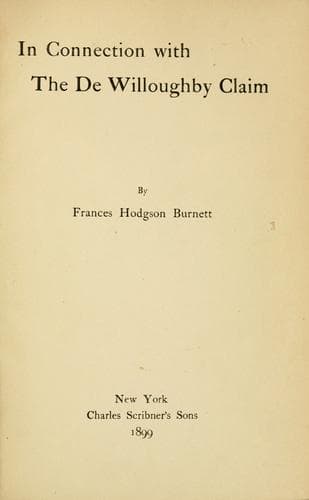
In Connection with the De Willoughby ClaimBurnett, Frances Hodgson
General
In Connection with the De Willoughby Claim
Burnett, Frances Hodgson
United States -- Social life and customs -- 19th century -- Fiction
He told his story as lightly as possible, but it could not be
transformed, by any lightness of touch, into an encouraging episode. He
made a picture of Stamps sidling through the barely opened door, and was
terse and witty at the expense of his own discomfiture and consciousness
of incompetence. He laughed at himself and made them laugh, but when he
sat down in his accustomed seat there was a shade upon his face.
The children exchanged glances, the eyes of each prompting the other.
They must be at their brightest. They knew the sight of their happiness
warmed and lightened his heart always.
"He is tired and hungry," Sheba said. "We must give him a beautiful hot
supper. Rupert, we must set the table."
They had grown used to waiting upon themselves, and their domestic
services wore more or less the air of festivities. Sheba ran downstairs
to Miss Burford's kitchen, where Uncle Matt had prepared the evening meal
in his best manner. As the repasts grew more and more simple, Matt seemed
to display greater accomplishments.
"It's all very well, Miss Sheba," he had said once, when she praised the
skill with which he employed his scant resources. "It's mighty easy to be
a good cook when you'se got everythin' right to han'. The giftness is to
git up a fine table when you ain't got nuffin'. Dat's whar dish yer
niggah likes to show out. De Lard knows I'se got too much yere dis ve'y
minnit--to be a-doin' credit to my 'sperience--too much, Miss Sheba."
He was frying hoe-cake and talking to Miss Burford when Sheba came into
the kitchen. He was a great comfort and aid to Miss Burford, and in a
genteel way the old lady found him a resource in the matters of
companionship and conversation. Her life was too pinched and narrow to
allow her even the simpler pleasure of social intercourse, and Matt's
journeys into the world, and his small adventures, and his comments upon
politics and social events were a solace and a source of entertainment to
her.
Just now he was describing to her the stories he had heard of a
celebrated lecturer who had just arrived in the city.
"Whether he's a 'vivalist or jes' a plain preacher what folks is runnin'
after, I cayn't quite make out, ma'am," he was saying. "I ain't quite
thinkin' he's a 'vivalist, but de peoples is a-runnin' after him
shore--an' seems like dey doin' it in ev'y city he goes to. Ev'ybody want
to heah him--ev'ybody--rich en pore--young en ole. De Rev'end John
Baird's his name, an' he's got a fren' travellin' with him as they say is
like Jonathan was to David in dese yere ole Bible times. An' I heern tell
ev when he rise in de pulpit de people's jest gets so worked up at what
he preach to 'em--dey jest cries an' rocks de benches. Dat's what make me
think he might be a 'vivalist--cos we all knows dat cryin' an' rockin'
an' clappin' hands is what makes a 'vival." He was full of anecdotes
concerning the new arrival whose reputation had plainly preceded him.
Public-domain text, read in full here on John Shaqi.
Reviews
Reviews
No reviews yet
Be the first to share your thoughts on this work.
Elsewhere in the archive
Join the Discussion
Join the discussion
Sign in to leave a comment or review.
Sign InorCreate an account