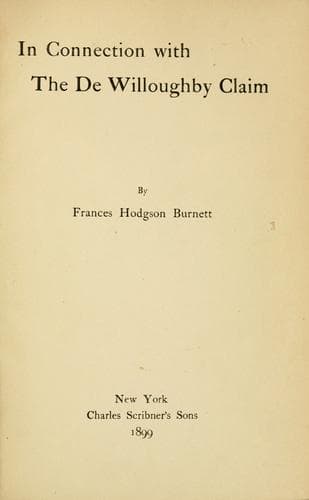
In Connection with the De Willoughby ClaimBurnett, Frances Hodgson
General
In Connection with the De Willoughby Claim
Burnett, Frances Hodgson
United States -- Social life and customs -- 19th century -- Fiction
The night was cold and damp, and rain was falling when the door closed
behind him. He heard it descending steadily throughout the evening, and
more than once the continuance of the downpour was commented upon by some
member of the company. When the guests separated for the night and
Latimer turned into the street again, he had scarcely walked five yards
before hearing a cough; he cast a glance over his shoulder and saw the
small man in blue jeans. The jeans were wet and water was dropping from
the brim of the old felt hat. The idea which at once possessed his mind
was that for some mysterious reason best known to himself the wearer had
been waiting for and was following him. What was it for? He turned about
suddenly and faced the person who seemed so unduly interested in his
actions.
"Do you want to speak to me?" he demanded.
This movement, being abrupt, rather upset Mr. Stamps's calculations. He
came to a standstill, looking surprised and nervous.
"Thar ain't no harm done," he said. "I aimed to find out whar ye lived."
"Have you been waiting for me to come out of the house?" asked Latimer,
feeling some curiosity.
Stamps admitted that he had, the admission being somewhat reluctant, as
if he felt it might commit him to something. Having so far betrayed
himself, however, he drew something nearer, with a suggestion of
stealthiness.
"Ye're mighty like a man I once knowed," he said. "Yer powerful like him.
I never seed two men more liker each other."
"Where did he live when you knew him?" Latimer enquired, the wretched,
dank little figure suddenly assuming the haunting air of something his
eye must have rested on before.
"I seen him in North Ca'llina. He did not live thar--in the way other
folks did. He was jest stayin'. I won't keep ye standin' in the rain,"
insinuatingly. "I'll jest walk along by ye."
Latimer walked on. This dragged him back again, as other things had done
once or twice. He did not speak, but strode on almost too rapidly for
Stamps's short legs. The short legs began to trot, and their owner to
continue his explanations rather breathlessly.
"He warn't livin' thar same as other folks," he said. "Thar was suthin'
curi's about him. Nobody knowed nothin' about him, an' nobody knew
nothin' about his wife. Now I come to think of it, nobody ever knowed his
name--but me."
"Did he tell it to you?" said Latimer, rigidly.
"No," with something verging on a chuckle, discreetly strangled at its
birth. "Neither him nor his wife was tellin' things just then. They was
layin' mighty low. She died when her child was borned, an' he lit out
right away an' ain't never been heern tell of since."
Latimer said nothing. The rain began to fall more heavily, and Mr. Stamps
trotted on.
"'Lowin' for store clothes an' agein'," he continued, "I never seen two
fellers favour each other as you two do. An' his name bein' the same as
yourn, makes it curi'ser still."
"You are getting very wet," was Latimer's sole comment.
Public-domain text, read in full here on John Shaqi.
Reviews
Reviews
No reviews yet
Be the first to share your thoughts on this work.
Elsewhere in the archive
Join the Discussion
Join the discussion
Sign in to leave a comment or review.
Sign InorCreate an account