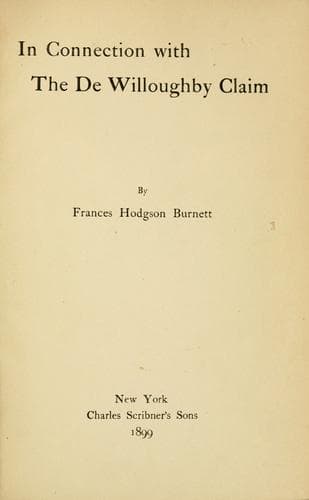
In Connection with the De Willoughby ClaimBurnett, Frances Hodgson
General
In Connection with the De Willoughby Claim
Burnett, Frances Hodgson
United States -- Social life and customs -- 19th century -- Fiction
Latimer's heart seemed physically to turn over in his side. He had never
known she had had a line of handwriting in her possession. This must be
some scrap of paper, some last, last words she clung to with such anguish
of desperation that she could not tear herself from them, and so had died
leaving them in their secret hiding-place. The thought was a shock. The
effort it cost him to regain his self-control was gigantic. But he
recovered his outward calm.
"You had better go home and change your clothing," he said, as coldly as
he had spoken before. "You are not a young man or a strong one, and you
may kill yourself. You are making a mistake about me; but if you will
give me your address I will see you again."
"I thort ye would--mebbe," said Stamps. "I thort mebbe ye would. They're
worth it."
And he scribbled a few words on a scrap of paper with a stump of a
pencil--producing both rapidly from his pocket--and thrusting it into
Latimer's hand, trotted away contentedly down the long wet street.
CHAPTER XXXVI
As he entered his rooms, Latimer glanced round at Baird's empty chair and
wished he had found him sitting in it. He walked over to it and sat down
himself--simply because it was Baird's chair and suggested his presence.
Latimer knew how he would have turned to look at him as he came in, and
that he would at once have known by instinct that the old abyss had been
re-opened.
"If he were here," he thought, "he would tell me what to do."
But he knew what he was going to do. He must buy the little hoosier's
silence if it was to be bought. He should see the letters. Through all
those months she had hidden them. He could imagine with what terror. She
could not bear to destroy them, and yet he knew there must have been
weeks she did not dare to go near their hiding-place. They must have been
concealed in some cranny of the cabin. How she must have shuddered with
dread when he had accidentally approached the spot where they lay
concealed. He recalled now that several times he had been wakened from
his sleep in the middle of the night by hearing her moving about her room
and sobbing. She had perhaps crept out of her bed in the darkness to find
these scraps of paper, to hold them in her hands, to crush them against
her heart, to cover them with piteous kisses, salt with scalding tears.
On one such night he had risen, and, going to the closed door, had spoken
to her through it, asking her if she was ill.
"No, no, Lucien," she had cried out, "but--but I am so lonely--so
lonely."
She had told him the next day that the sound of the wind soughing in the
pines had kept her from sleep, and she had got up because she could not
bear to be still and listen.
Public-domain text, read in full here on John Shaqi.
Reviews
Reviews
No reviews yet
Be the first to share your thoughts on this work.
Elsewhere in the archive
Join the Discussion
Join the discussion
Sign in to leave a comment or review.
Sign InorCreate an account