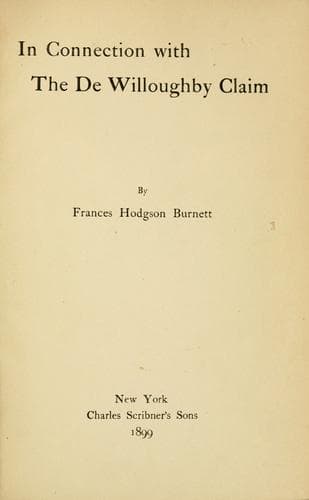
In Connection with the De Willoughby ClaimBurnett, Frances Hodgson
General
In Connection with the De Willoughby Claim
Burnett, Frances Hodgson
United States -- Social life and customs -- 19th century -- Fiction
His writing of the last sentence cheered his spirits. It was a support to
his small, ignorant cunning. "He'll think someone else is biddin' agen
him," he said. "Ef there was two of 'em biddin', I could get most
anythin' I axed."
After he had put the communication in an envelope he dragged himself to
the door almost bent double by the stabbing pain in his side. Once there
he sat down on the floor to listen for footsteps.
"It's hard work this yere," he panted, shivering with cold in spite of
his fever, "but it's better than a-lyin' thar doin' nothin'."
At length he heard steps. They were the running, stamping feet of a boy
who whistled as he came.
Stamps opened the door and whistled himself--a whistle of summons and
appeal. The boy, who was on his way with a message to another room,
hesitated a minute and then came forward, staring at the sight of the
little, undressed, shivering man with his head thrust into the passage.
"Hallo!" he said, "what d'yer want?"
"Want ye to carry this yere letter to a man," Stamps got out hoarsely.
"I'll give ye a quarter. Will ye do it?"
"Yes." And he took both note and money, still staring at the abnormal
object before him.
When the messenger arrived Latimer was reading the letters which had
arrived by the last delivery. One of them was from Baird, announcing the
hour of his return to the city. Latimer held it in his hand when Stamps's
communication was brought to him.
"Tell the messenger that I will come," he said.
* * * * *
It was not long before Stamps heard his slow approach sounding upon the
bare wooden stairs. He mounted the steps deliberately because he was
thinking. He was thinking as he had thought on his way through the
streets. In a few minutes he should be holding in his hand letters
written by the man who had been Margery's murderer--the letters she had
hidden and clung to and sobbed over in the blackness of her nights. And
they had been written twenty years ago, and Margery had changed to dust
on the hillside under the pines. And nothing could be undone and nothing
softened. But for the sake of the little old woman ending her days
quietly in Willowfield--and for the sake of Margery's memory--yes, he
wanted to save the child's memory--but for these things there would be no
use in making any effort to secure the papers. Yet he was conscious of a
dread of the moment when he should take them into his hand.
Stamps turned eager, miserable eyes upon him as he came in.
"I thought mebbe ye'd made up yer mind to let the other feller hev them,"
he said. "Hev ye brought the money in bills?"
Latimer stood and looked down at him. "Do you know how ill you are?" he
said.
"Wal, I guess I kin feel a right smart--but I don't keer so's things
comes my way. Hev ye got the money with ye?"
"Yes. Where are the papers?"
"Whar's the money?"
Latimer took out a pocket-book and opened it that he might see.
Stamps's countenance relaxed. The tension was relieved.
Public-domain text, read in full here on John Shaqi.
Reviews
Reviews
No reviews yet
Be the first to share your thoughts on this work.
Elsewhere in the archive
Join the Discussion
Join the discussion
Sign in to leave a comment or review.
Sign InorCreate an account