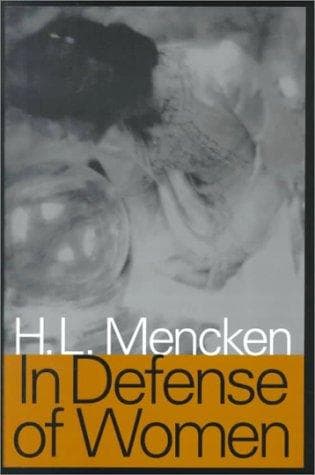
Sexism; Women -- Social and moral questions; Women -- Social conditions
Here we unearth another factor: the fascination of what is strange, the
charm of the unlike, _heliogabalisme_. As Shakespeare has put it, there
must be some mystery in love—and there can be no mystery between
intellectual equals. I dare say that many a woman marries an inferior
man, not primarily because he is a good provider (though it is
impossible to imagine her overlooking this), but because his very
inferiority interests her, and makes her want to remedy it and mother
him. Egoism is in the impulse: it is pleasant to have a feeling of
superiority, and to be assured that it can be maintained. If now, that
feeling be mingled with sexual curiosity and economic self-interest, it
obviously supplies sufficient motivation to account for so natural and
banal a thing as a marriage. Perhaps the greatest of all these factors
is the mere disparity, the naked strangeness. A woman could not love a
man, as the phrase is, who wore skirts and pencilled his eye-brows, and
by the same token she would probably find it difficult to love a man
who matched perfectly her own sharpness of mind. What she most esteems
in marriage, on the psychic plane, is the chance it offers for the
exercise of that caressing irony which I have already described. She
likes to observe that her man is a fool—dear, perhaps, but none the
less damned. Her so-called love for him, even at its highest, is always
somewhat pitying and patronizing.
27. The Charm of Mystery
Monogamous marriage, by its very conditions, tends to break down this
strangeness. It forces the two contracting parties into an intimacy
that is too persistent and unmitigated; they are in contact at too many
points, and too steadily. By and by all the mystery of the relation is
gone, and they stand in the unsexed position of brother and sister.
Thus that “maximum of temptation” of which Shaw speaks has within
itself the seeds of its own decay. A husband begins by kissing a pretty
girl, his wife; it is pleasant to have her so handy and so willing. He
ends by making machiavellian efforts to avoid kissing the every day
sharer of his meals, books, bath towels, pocketbook, relatives,
ambitions, secrets, malaises and business: a proceeding about as
romantic as having his boots blacked. The thing is too horribly dismal
for words. Not all the native sentimentalism of man can overcome the
distaste and boredom that get into it. Not all the histrionic capacity
of woman can attach any appearance of gusto and spontaneity to it.
Public-domain text, read in full here on John Shaqi.
Reviews
Reviews
No reviews yet
Be the first to share your thoughts on this work.
Elsewhere in the archive
Join the Discussion
Join the discussion
Sign in to leave a comment or review.
Sign InorCreate an account