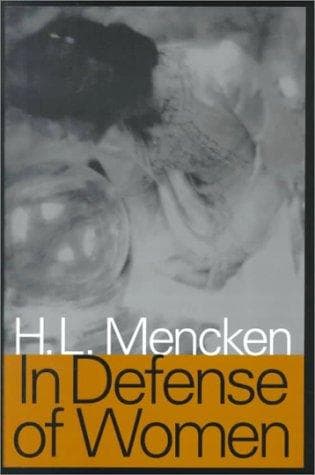
Sexism; Women -- Social and moral questions; Women -- Social conditions
This boredom of marriage, however, is not nearly so dangerous a menace
to the institution as Mrs. Cox, with evangelistic enthusiasm, permits
herself to think it is. It bears most harshly upon the wife, who is
almost always the more intelligent of the pair; in the case of the
husband its pains are usually lightened by that sentimentality with
which men dilute the disagreeable, particularly in marriage. Moreover,
the average male gets his living by such depressing devices that
boredom becomes a sort of natural state to him. A man who spends six or
eight hours a day acting as teller in a bank, or sitting upon the bench
of a court, or looking to the inexpressibly trivial details of some
process of manufacturing, or writing imbecile articles for a newspaper,
or managing a tramway, or administering ineffective medicines to stupid
and uninteresting patients—a man so engaged during all his hours of
labour, which means a normal, typical man, is surely not one to be
oppressed unduly by the dull round of domesticity. His wife may bore
him hopelessly as mistress, just as any other mistress inevitably bores
a man (though surely not so quickly and so painfully as a lover bores a
woman), but she is not apt to bore him so badly in her other
capacities. What he commonly complains about in her, in truth, is not
that she tires him by her monotony, but that she tires him by her
variety—not that she is too static, but that she is too dynamic. He is
weary when he gets home, and asks only the dull peace of a hog in a
comfortable sty. This peace is broken by the greater restlessness of
his wife, the fruit of her greater intellectual resilience and
curiosity.
Public-domain text, read in full here on John Shaqi.
Reviews
Reviews
No reviews yet
Be the first to share your thoughts on this work.
Elsewhere in the archive
Join the Discussion
Join the discussion
Sign in to leave a comment or review.
Sign InorCreate an account