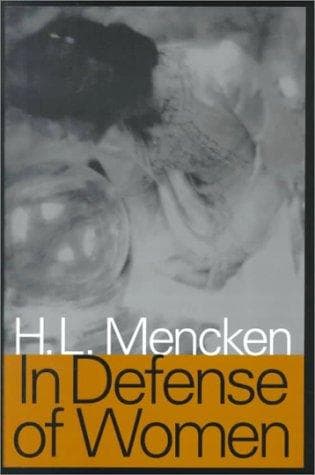
Sexism; Women -- Social and moral questions; Women -- Social conditions
Of far more potency as a cause of connubial discord is the general
inefficiency of a woman at the business of what is called keeping
house—a business founded upon a complex of trivial technicalities. As I
have argued at length, women are congenitally less fitted for mastering
these technicalities than men; the enterprise always costs them more
effort, and they are never able to reinforce mere diligent application
with that obtuse enthusiasm which men commonly bring to their tawdry
and childish concerns. But in addition to their natural incapacity,
there is a reluctance based upon a deficiency in incentive, and
deficiency in incentive is due to the maudlin sentimentality with which
men regard marriage. In this sentimentality lie the germs of most of
the evils which beset the institution in Christendom, and particularly
in the United States, where sentiment is always carried to inordinate
lengths. Having abandoned the mediaeval concept of woman as temptress
the men of the Nordic race have revived the correlative mediaeval
concept of woman as angel and to bolster up that character they have
create for her a vast and growing mass of immunities culminating of
late years in the astounding doctrine that, under the contract of
marriage, all the duties lie upon the man and all the privileges
appertain to the woman. In part this doctrine has been established by
the intellectual enterprise and audacity of woman. Bit by bit, playing
upon masculine stupidity, sentimentality and lack of strategical sense,
they have formulated it, developed it, and entrenched it in custom and
law. But in other part it is the plain product of the donkeyish vanity
which makes almost every man view the practical incapacity of his wife
as, in some vague way, a tribute to his own high mightiness and
consideration. Whatever is revolt against her immediate indolence and
efficiency, his ideal is nearly always a situation in which she will
figure as a magnificent drone, a sort of empress without portfolio,
entirely discharged from every unpleasant labour and responsibility.
29. Marriage and the Law
This was not always the case. No more than a century ago, even by
American law, the most sentimental in the world, the husband was the
head of the family firm, lordly and autonomous. He had authority over
the purse-strings, over the children, and even over his wife. He could
enforce his mandates by appropriate punishment, including the corporal.
His sovereignty and dignity were carefully guarded by legislation, the
product of thousands of years of experience and ratiocination. He was
safeguarded in his self-respect by the most elaborate and efficient
devices, and they had the support of public opinion.
Public-domain text, read in full here on John Shaqi.
Reviews
Reviews
No reviews yet
Be the first to share your thoughts on this work.
Elsewhere in the archive
Join the Discussion
Join the discussion
Sign in to leave a comment or review.
Sign InorCreate an account