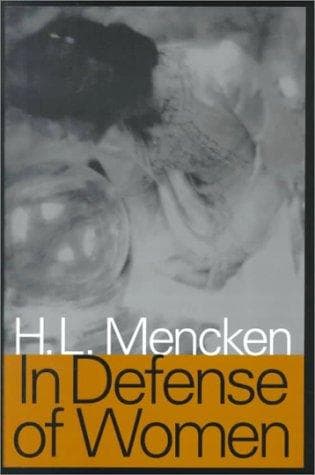
Sexism; Women -- Social and moral questions; Women -- Social conditions
Once the women of Christendom become at ease in the use of the ballot,
and get rid of the preposterous harridans who got it for them and who
now seek to tell them what to do with it, they will proceed to a
scotching of many of the sentimentalities which currently corrupt
politics. For one thing, I believe that they will initiate measures
against democracy—the worst evil of the present-day world. When they
come to the matter, they will certainly not ordain the extension of the
suffrage to children, criminals and the insane in brief, to those ever
more inflammable and knavish than the male hinds who have enjoyed it
for so long; they will try to bring about its restriction, bit by bit,
to the small minority that is intelligent, agnostic and
self-possessed—say six women to one man. Thus, out of their greater
instinct for reality, they will make democracy safe for a democracy.
The curse of man, and the cause of nearly all his woes, is his
stupendous capacity for believing the incredible. He is forever
embracing delusions, and each new one is worse than all that have gone
before. But where is the delusion that women cherish—I mean habitually,
firmly, passionately? Who will draw up a list of propositions, held and
maintained by them in sober earnest, that are obviously not true? (I
allude here, of course, to genuine women, not to suffragettes and other
such pseudo-males). As for me, I should not like to undertake such a
list. I know of nothing, in fact, that properly belongs to it. Women,
as a class, believe in none of the ludicrous rights, duties and pious
obligations that men are forever gabbling about. Their superior
intelligence is in no way more eloquently demonstrated than by their
ironical view of all such phantasmagoria. Their habitual attitude
toward men is one of aloof disdain, and their habitual attitude toward
what men believe in, and get into sweats about, and bellow for, is
substantially the same. It takes twice as long to convert a body of
women to some new fallacy as it takes to convert a body of men, and
even then they halt, hesitate and are full of mordant criticisms. The
women of Colorado had been voting for 21 years before they succumbed to
prohibition sufficiently to allow the man voters of the state to adopt
it; their own majority voice was against it to the end. During the
interval the men voters of a dozen non-suffrage American states had
gone shrieking to the mourners’ bench. In California, enfranchised in
1911, the women rejected the dry revelation in 1914. National
prohibition was adopted during the war without their votes—they did not
get the franchise throughout the country until it was in the
Constitution—and it is without their support today. The American man,
despite his reputation for lawlessness, is actually very much afraid of
the police, and in all the regions where prohibition is now actually
enforced he makes excuses for his poltroonish acceptance of it by
Public-domain text, read in full here on John Shaqi.
Reviews
Reviews
No reviews yet
Be the first to share your thoughts on this work.
Elsewhere in the archive
Join the Discussion
Join the discussion
Sign in to leave a comment or review.
Sign InorCreate an account