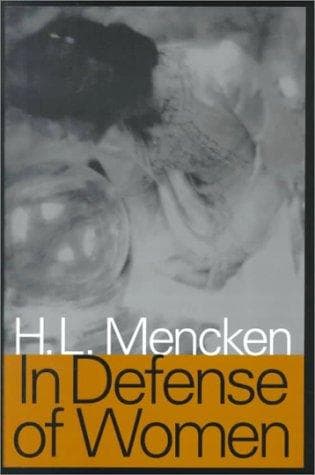
Sexism; Women -- Social and moral questions; Women -- Social conditions
The officers nominated by the male electorate in modern democracies
before the extension of the suffrage were usually chosen, not for their
competence but for their mere talent for idiocy; they reflected
accurately the male weakness for whatever is rhetorical and sentimental
and feeble and untrue. Consider, for example, what happened in a
salient case. Every four years the male voters of the United States
chose from among themselves one who was put forward as the man most
fit, of all resident men, to be the first citizen of the commonwealth.
He was chosen after interminable discussion; his qualifications were
thoroughly canvassed; very large powers and dignities were put into his
hands. Well, what did we commonly find when we examined this gentleman?
We found, not a profound thinker, not a leader of sound opinion, not a
man of notable sense, but merely a wholesaler of notions so infantile
that they must needs disgust a sentient suckling—in brief, a spouting
geyser of fallacies and sentimentalities, a cataract of unsupported
assumptions and hollow moralizings, a tedious phrase-merchant and
platitudinarian, a fellow whose noblest flights of thought were
flattered when they were called comprehensible—specifically, a Wilson,
a Taft, a Roosevelt, or a Harding.
This was the male champion. I do not venture upon the cruelty of
comparing his bombastic flummeries to the clear reasoning of a woman of
like fame and position; all I ask of you is that you weigh them, for
sense, for shrewdness, for intelligent grasp of obscure relations, for
intellectual honesty and courage, with the ideas of the average
midwife.
34. The Suffragette
I have spoken with some disdain of the suffragette. What is the matter
with her, fundamentally, is simple: she is a woman who has stupidly
carried her envy of certain of the superficial privileges of men to
such a point that it takes on the character of an obsession, and makes
her blind to their valueless and often chiefly imaginary character. In
particular, she centres this frenzy of hers upon one definite
privilege, to wit, the alleged privilege of promiscuity in amour, the
modern droit du seigneur. Read the books of the chief lady Savonarolas,
and you will find running through them an hysterical denunciation of
what is called the double standard of morality; there is, indeed, a
whole literature devoted exclusively to it. The existence of this
double standard seems to drive the poor girls half frantic. They bellow
raucously for its abrogation, and demand that the frivolous male be
visited with even more idiotic penalties than those which now visit the
aberrant female; some even advocate gravely his mutilation by surgery,
that he may be forced into rectitude by a physical disability for sin.
Public-domain text, read in full here on John Shaqi.
Reviews
Reviews
No reviews yet
Be the first to share your thoughts on this work.
Elsewhere in the archive
Join the Discussion
Join the discussion
Sign in to leave a comment or review.
Sign InorCreate an account