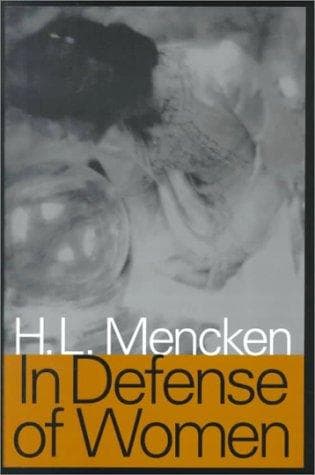
Sexism; Women -- Social and moral questions; Women -- Social conditions
This feminine craving for martyrdom, of course, often takes on a
downright pathological character, and so engages the psychiatrist.
Women show many other traits of the same sort. To be a woman under our
Christian civilization, indeed, means to live a life that is heavy with
repression and dissimulation, and this repression and dissimulation, in
the long run, cannot fail to produce effects that are indistinguishable
from disease. You will find some of them described at length in any
handbook on psychoanalysis. The Viennese, Adler, and the Dane, Poul
Bjerre, argue, indeed, that womanliness itself, as it is encountered
under Christianity, is a disease. All women suffer from a suppressed
revolt against the inhibitions forced upon them by our artificial
culture, and this suppressed revolt, by well known Freudian means,
produces a complex of mental symptoms that is familiar to all of us. At
one end of the scale we observe the suffragette, with her grotesque
adoption of the male belief in laws, phrases and talismans, and her
hysterical demand for a sexual libertarianism that she could not put to
use if she had it. And at the other end we find the snuffling and
neurotic woman, with her bogus martyrdom, her extravagant pruderies and
her pathological delusions. As Ibsen observed long ago, this is a man’s
world. Women have broken many of their old chains, but they are still
enmeshed in a formidable network of man-made taboos and
sentimentalities, and it will take them another generation, at least,
to get genuine freedom. That this is true is shown by the deep unrest
that yet marks the sex, despite its recent progress toward social,
political and economic equality. It is almost impossible to find a man
who honestly wishes that he were a woman, but almost every woman, at
some time or other in her life, is gnawed by a regret that she is not a
man.
Public-domain text, read in full here on John Shaqi.
Reviews
Reviews
No reviews yet
Be the first to share your thoughts on this work.
Elsewhere in the archive
Join the Discussion
Join the discussion
Sign in to leave a comment or review.
Sign InorCreate an account