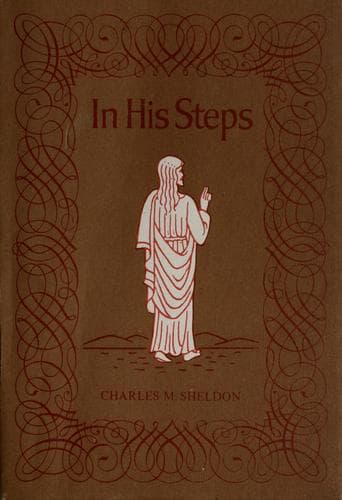
Christian fiction; Clergy -- Fiction; Jesus Christ -- Influence -- Fiction
The winter was gone and the year was ended, the year which Henry
Maxwell had fixed as the time during which the pledge should be kept
to do as Jesus would do. Sunday, the anniversary of that one a year
ago, was in many ways the most remarkable day that the First Church
ever knew. It was more important than the disciples in the First
Church realized. The year had made history so fast and so serious
that the people were not yet able to grasp its significance. And the
day itself which marked the completion of a whole year of such
discipleship was characterized by such revelations and confessions
that the immediate actors in the events themselves could not
understand the value of what had been done, or the relation of their
trial to the rest of the churches and cities of the country.
It happened that the week before that anniversary Sunday the Rev.
Calvin Bruce, D.D., of the Nazareth Avenue Church, Chicago, was
in Raymond, where he had come on a visit to some old friends, and
incidentally to see his old seminary classmate, Henry Maxwell. He
was present at the First Church and was an exceedingly attentive
and interested spectator. His account of the events in Raymond, and
especially of that Sunday, may throw more light on the entire situation
than any description or record from other sources.
Chapter Nineteen
[Letter from Rev. Calvin Bruce, D.D., of the Nazareth Avenue Church,
Chicago, to Rev. Philip A. Caxton, D.D., New York City.]
"My Dear Caxton:
"It is late Sunday night, but I am so intensely awake and so
overflowing with what I have seen and heard that I feel driven to
write you now some account of the situation in Raymond as I have
been studying it, and as it has apparently come to a climax today.
So this is my only excuse for writing so extended a letter at this
time.
"You remember Henry Maxwell in the Seminary. I think you said the
last time I visited you in New York that you had not seen him since
we graduated. He was a refined, scholarly fellow, you remember, and
when he was called to the First Church of Raymond within a year
after leaving the Seminary, I said to my wife, 'Raymond has made a
good choice. Maxwell will satisfy them as a sermonizer.' He has been
here eleven years, and I understand that up to a year ago he had
gone on in the regular course of the ministry, giving good
satisfaction and drawing good congregations. His church was counted
the largest and wealthiest church in Raymond. All the best people
attended it, and most of them belonged. The quartet choir was famous
for its music, especially for its soprano, Miss Winslow, of whom I
shall have more to say; and, on the whole, as I understand the
facts, Maxwell was in a comfortable berth, with a very good salary,
pleasant surroundings, a not very exacting parish of refined, rich,
respectable people--such a church and parish as nearly all the young
men of the seminary in our time looked forward to as very desirable.
Public-domain text, read in full here on John Shaqi.
Reviews
Reviews
No reviews yet
Be the first to share your thoughts on this work.
Elsewhere in the archive
Join the Discussion
Join the discussion
Sign in to leave a comment or review.
Sign InorCreate an account