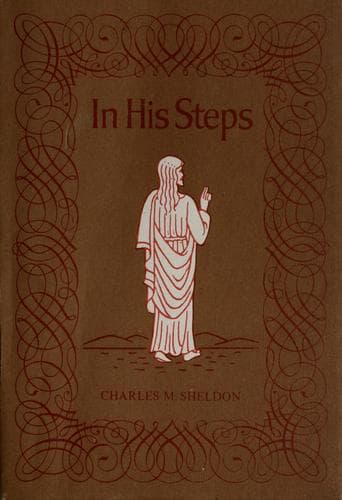
Christian fiction; Clergy -- Fiction; Jesus Christ -- Influence -- Fiction
Virginia's conduct, her presence every night with Rachel, her
absence from the usual circle of her wealthy, fashionable
acquaintances, had furnished a great deal of material for gossip and
question. In addition to these events which centered about these
persons who were so well known, there had been all through the city
in very many homes and in business and social circles strange
happenings. Nearly one hundred persons in Henry Maxwell's church had
made the pledge to do everything after asking: "What would Jesus
do?" and the result had been, in many cases, unheard-of actions. The
city was stirred as it had never been before. As a climax to the
week's events had come the spiritual manifestation at the Rectangle,
and the announcement which came to most people before church time of
the actual conversion at the tent of nearly fifty of the worst
characters in that neighborhood, together with the con version of
Rollin Page, the well-known society and club man.
It is no wonder that under the pressure of all this the First Church
of Raymond came to the morning service in a condition that made it
quickly sensitive to any large truth. Perhaps nothing had astonished
the people more than the great change that had come over the
minister, since he had proposed to them the imitation of Jesus in
conduct. The dramatic delivery of his sermons no longer impressed
them. The self-satisfied, contented, easy attitude of the fine
figure and refined face in the pulpit had been displaced by a manner
that could not be compared with the old style of his delivery. The
sermon had become a message. It was no longer delivered. It was
brought to them with a love, an earnestness, a passion, a desire, a
humility that poured its enthusiasm about the truth and made the
speaker no more prominent than he had to be as the living voice of
God. His prayers were unlike any the people had heard before. They
were often broken, even once or twice they had been actually
ungrammatical in a phrase or two. When had Henry Maxwell so far
forgotten himself in a prayer as to make a mistake of that sort? He
knew that he had often taken as much pride in the diction and
delivery of his prayers as of his sermons. Was it possible he now so
abhorred the elegant refinement of a formal public petition that he
purposely chose to rebuke himself for his previous precise manner of
prayer? It is more likely that he had no thought of all that. His
great longing to voice the needs and wants of his people made him
unmindful of an occasional mistake. It is certain that he had never
prayed so effectively as he did now.
Public-domain text, read in full here on John Shaqi.
Reviews
Reviews
No reviews yet
Be the first to share your thoughts on this work.
Elsewhere in the archive
Join the Discussion
Join the discussion
Sign in to leave a comment or review.
Sign InorCreate an account