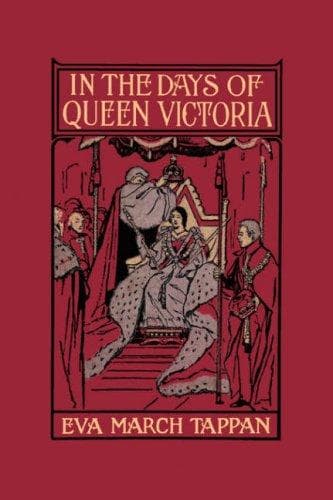
Great Britain -- History -- Victoria, 1837-1901 -- Fiction
With all these family celebrations, indeed with almost every action of
the Queen's life, John Brown was closely associated. In private and in
public he was the attendant of his sovereign, ever on the watch to save
her, not only from danger, but from the least annoyance. On one
occasion, the Queen's carriage stopped in a village after dark, and
curious people thronged about. One man actually held up a lantern to
get a plainer view of her face, but all that met his eyes was the
rugged, determined features of John Brown, for the faithful man had
calmly put himself between the Queen and her inquisitive subject. On
another occasion, a woman pushed up to the carriage and stood leaning
upon the wheel and staring at the Queen. John Brown thought it a waste
of courtesy to be gentle with such a person, and he growled "Be off
with you!" like an angry policeman to a crowd of troublesome
ragamuffins. In 1883 this faithful servant died. There could hardly
have been a time when the Queen had more need of him, for by a fall on
the staircase at Windsor she had become unable to walk or even to
stand.
During the months of her lameness, she prepared for publication a
volume of extracts from her journal for 1862 to 1882. The dedication
read, "To My Loyal Highlanders, and especially to the memory of my
devoted personal attendant, John Brown." She was as modest about this
book as about the first one, and with the copy that she presented to
Tennyson she sent an almost shy little note saying, "Though a very
humble and unpretending author, I send you my new book, which perhaps
you may like to glance at. Its only merit is its simplicity and truth."
The Queen's lameness did not prevent her from making her usual spring
visit to Balmoral in 1884, but the most unusual precautions were taken
to insure her safety. Within two or three years the Emperor of Russia
had been assassinated, and in London several attempts had been made
recently to blow up public buildings with dynamite. Generally when the
Queen traveled, her time-table was known, and people were at every
station to give her welcome. An engine was always sent before the train
to make sure that the road was clear, but this time, however, the
time-tables were kept secret, and no spectators were allowed to gather
at the stations. Men were usually at work on the road, averaging one to
every half-mile. These men were now supplied with flags to wave as the
train came in sight. If the engineer saw a white flag, he knew the way
was clear for half a mile; but if the red one was waved, he knew there
was danger or some obstruction ahead, and that he must stop at once.
Public-domain text, read in full here on John Shaqi.
Reviews
Reviews
No reviews yet
Be the first to share your thoughts on this work.
Elsewhere in the archive
Join the Discussion
Join the discussion
Sign in to leave a comment or review.
Sign InorCreate an account