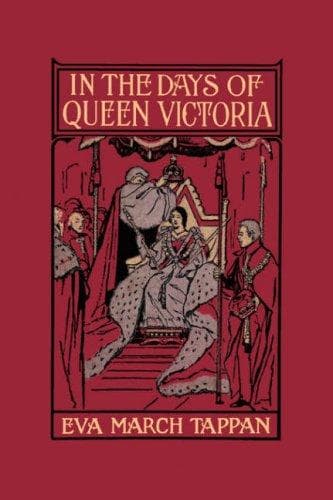
Great Britain -- History -- Victoria, 1837-1901 -- Fiction
Then came the act of coronation, but for this Victoria was not to
appear in jewels and ermine. She was escorted to one of the chapels and
robed in a flowing gown of fine white muslin. Over this was thrown a
robe of gold brocade worked with the rose, the shamrock, and the
thistle emblematic of England, Ireland, and Scotland. In this quaint
and ancient costume she knelt before the altar. The Archbishop led her
to the famous old chair of St. Edward, wherein was the stone of Scone,
and touched her head and hands with the holy oil. The scepter, orb,
sword, and other things signifying power and authority in either Church
or state, were handed to her, each with a few words from the
Archbishop, exhorting her to use it properly. The ruby ring was placed
upon her finger, and the cloth-of-gold mantle upon her shoulders. Then
the Archbishop slowly lifted the crown, which was blazing with
diamonds, sapphires, rubies, and emeralds, and placed it upon her head.
The next moment all the peers and peeresses lifted their coronets and
put them on. The whole building flashed and glittered until one might
have fancied that it was raining diamonds. "God save the Queen!" echoed
and re-echoed. The thousands who stood outside the Abbey caught up the
cry, the bells of all the churches in London began to ring, and the
guns of all the garrison towns were fired.
[Illustration: The Coronation of Queen Victoria.
(_From painting by Sir George Hayter._)]
The ceremony of homage followed. The Archbishop, the two royal dukes,
and many other dukes, marquises, earls, viscounts, and barons knelt
and, kissing her hand, said: "I do become your liege man of life and
limb, and of earthly worship, and faith and truth I will bear unto you,
to live and die against all manner of folk, so help me God!" One of the
peers was so aged and infirm that he tried twice in vain to ascend the
steps. The Queen rose and moved toward him and extended her hand to him
as simply and naturally as any other young girl might have done who was
not sitting on a throne. After the homage, she received the Holy
Sacrament; the "Hallelujah Chorus" was sung; and then the procession
re-formed and went slowly over the way to Buckingham Palace.
When George III. was crowned, he complained of some blunders that were
made, but he could hardly have been much comforted by the reply that
matters would "go better next time." Even though Victoria was the third
sovereign crowned since the time of George III., there were still some
mistakes. England was accustomed to crowning strong men, but not
slender young girls, and the orb was made so heavy that holding it was
very wearisome, while the ruby ring was made for the little finger and
had to be forced upon the ring finger as best it could be. When the
peers did homage, they were required to touch the crown; and the Queen
said it was fortunate that she had had it made as tight as possible,
for many of them knocked it, and one actually clutched it.
Public-domain text, read in full here on John Shaqi.
Reviews
Reviews
No reviews yet
Be the first to share your thoughts on this work.
Elsewhere in the archive
Join the Discussion
Join the discussion
Sign in to leave a comment or review.
Sign InorCreate an account