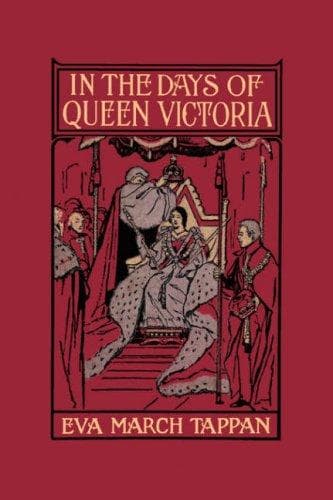
Great Britain -- History -- Victoria, 1837-1901 -- Fiction
The Queen tried to make her children understand that they were no
better than other children just because they were princes or
princesses, and they were obliged to behave with perfect courtesy to
the servants of the palace as well as to kings and emperors. It is said
that once upon a time two of the children thought it very amusing to
take possession of the brushes and blacken the face of a woman who was
cleaning a stove; but when the Queen mother discovered their prank, she
took the small culprits by the hand and led them to the woman's room
and made them apologize most humbly. The little Princess Royal "Vicky"
was so independent a young lady that she would sometimes break through
her mother's teachings. The story is told that one day a sailor lifted
her on board the royal yacht, saying as he sat her down, "There you
are, my little lady." "I'm a princess I'm not a little lady," the child
retorted; but the watchful mother was listening, and she said, "That is
true. Tell the kind sailor that you are not a little lady yet, but that
you hope to be some day." Occasionally this willful little Princess
preferred to bear a punishment rather than give up her own way. The
Queen and the Prince addressed Dr. Brown as "Brown," and the small
child followed their example. "You will be sent to bed if you do that
again," said the Queen, but the next morning when Dr. Brown appeared,
the little girl said with special distinctness: "Good morning, Brown,
and good night, Brown, for I'm going to bed, Brown," and, with her
saucy little head high in the air, she marched off to bed.
Happy as the Queen and the Prince were in their home life, one subject
in connection with her husband always troubled the loving wife, and
that was the annoying question of precedence. She wrote of him in her
journal: "He is above me in everything really, and therefore I wish
that he should be equal in rank to me." In England she could "put the
Prince where she wished him to be," but Parliament had given him no
rank, and therefore out of England some sovereigns, like King Ernest,
positively refused to grant him any honors that were not due to the
younger son of the Duke of Coburg; and when precedence was accorded
him, the Queen had to express gratitude as for a personal favor to
herself. Unknown to the Prince, she had a long talk on the subject with
Baron Stockmar.
"I wish him to have the title of King Consort," she said earnestly.
"A king consort without the authority of a king would be a novelty,"
replied the Baron, "and the English people do not like anything for
which there is no precedent. Queen Anne's husband was never called
king."
"But Queen Anne's husband was stupid and insignificant," declared the
Queen. "There has never been a case like ours before. Albert and I
reign together. He is sovereign as much as I. We discuss all matters
and decide together."
Public-domain text, read in full here on John Shaqi.
Reviews
Reviews
No reviews yet
Be the first to share your thoughts on this work.
Elsewhere in the archive
Join the Discussion
Join the discussion
Sign in to leave a comment or review.
Sign InorCreate an account