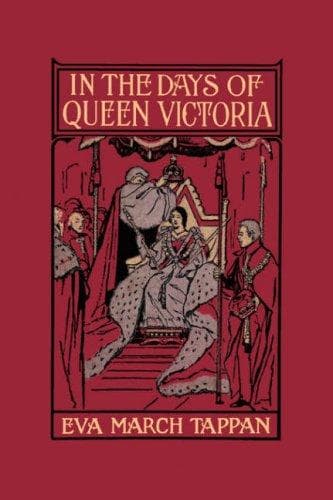
Great Britain -- History -- Victoria, 1837-1901 -- Fiction
When the Irish visit had come to its end, and the Queen was about to
leave for England, the crowds on the shore cheered her more wildly than
ever, and both the Queen and the Prince climbed the paddlebox and waved
their handkerchiefs again and again. "Go slowly," ordered the Queen,
and the boat moved very slowly along, keeping close to the pier. The
crowds cheered with more enthusiasm than before, and three times a
return was given to their salute by lowering the royal standard. One of
the Queen's party said: "There is not an individual in the town who
does not take the Queen's going on the paddlebox and lowering the royal
standard as a personal compliment to himself."
The year following the visit to Ireland the Queen's seventh child was
born, a boy.
"Now we are just as many as the days of the week," cried the brothers
and sisters joyfully.
"But which of us shall be Sunday?" asked one.
"The new baby," answered Princess "Vicky" decidedly, "because he's just
come, and we must be polite to him and give him the best."
The little boy was named Patrick, as the old woman in Ireland had
suggested, but his first name was Arthur, for the Duke of Wellington,
on whose eighty-first birthday he was born.
The days of the Queen were full of joys and sorrows that came almost
hand in hand. Her home life was perfectly happy, but her duties as a
sovereign took much time that she would have gladly given to her
family. "It is hard," she said, "that I cannot always hear my children
say their prayers." She had the warmest, most devoted friends, but in
the six years preceding 1850, she had lost several who could never be
replaced. Sir Robert Peel and Lord Melbourne had died, the opposing
Ministers who had both won her confidence and gratitude; and the "good
Queen Adelaide," who had loved the little Princess Victoria as if she
had been her own child, was also gone. The sorrow which Prince Albert
felt at the loss of his father had been to his wife a grief almost as
deep; and both she and the Prince were saddened by the loss of the
Coburg grandmother, who loved him so that she was almost heartbroken on
his leaving her to make his home in England, and called piteously after
his carriage, "Oh, Albert, Albert!" The three who had been nearest to
the Queen in her childhood were living, her mother, Dr. Davys, and
Baroness Lehzen. The kind, scholarly clergyman she had made Bishop of
Peterborough, and she saw him from time to time. After the marriage of
the Queen the Baroness Lehzen returned to her friends in Germany, but
the busy sovereign found time to send her long and frequent letters.
Public-domain text, read in full here on John Shaqi.
Reviews
Reviews
No reviews yet
Be the first to share your thoughts on this work.
Elsewhere in the archive
Join the Discussion
Join the discussion
Sign in to leave a comment or review.
Sign InorCreate an account