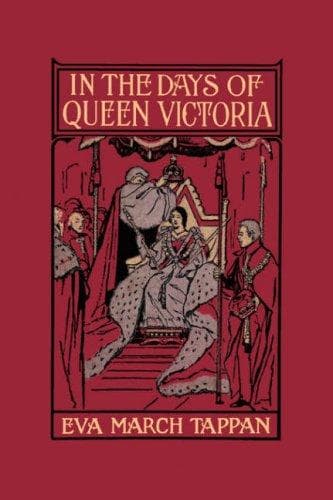
Great Britain -- History -- Victoria, 1837-1901 -- Fiction
The Queen was always against war, but when it was finally declared,
early in 1854, she did everything in her power for the success of
England. When the first regiments that were ready to go to the Crimea
marched through the courtyard of Buckingham Palace, she and the Prince
stood on the balcony as enthusiastic as the troops. Then she hastened
to Osborne to say farewell to the warships that were starting for the
Baltic. Prince Alfred had already made up his mind to be a sailor, and
the Duke's little namesake was destined to follow the Duke's example
and be a soldier, but they were as yet only small children, and the
Queen exclaimed, "How I wish I had two sons in the army now and two in
the navy!" Nothing that affected the war was too great or too small for
her to notice, and she had a definite opinion on every subject.
"Your Majesty," said Lord Aberdeen, the Prime Minister, "it is proposed
to have a day of humiliation and fasting for the success of our arms."
"I approve most heartily of a day of prayer," declared the Queen, "but
not of calling it a day of humiliation. We are not humiliated. It is
not our wickedness, but the selfish ambition and want of honesty of the
Emperor which have brought on this war. We believe that our cause is
just, and that we are contending for what is right."
"But it has long been the custom to call such days times of fasting and
prayer," the Prime Minister suggested.
"We will thank God for the blessings we have enjoyed," said the Queen,
"and ask His help and protection, but it is my particular wish that we
call the day one of prayer and supplication."
The war was begun, and during the two years following, no one in the
land suffered more intensely than the Queen. A powerful nation is
always inclined to expect that its enemies may be crushed at a blow,
but Russia was not so easily crushed.
The Queen was prepared for battles lost and battles won, but not for
blunders and poor management; and to a woman as prompt and as careful
of details as she, such faults were unpardonable. Before many months
came the report of the Charge of the Light Brigade, which Tennyson has
made famous in his poem. This useless charge by which six hundred men
were sent to attack an army was caused by a mistake. "Someone had
blundered." Thousands of copies of the poem were printed and sent to
the soldiers who were besieging Sebastopol.
The Queen was in constant anxiety. Telegrams were false and misleading,
and if one brought good news in the morning, she dared not rejoice lest
it should be contradicted before night. It was then that the work of
the "special correspondent" began, for a physician who was at the scene
of the war sent letters to the _London Times_, and for the first time,
the people at home knew the daily life of their soldiers.
Public-domain text, read in full here on John Shaqi.
Reviews
Reviews
No reviews yet
Be the first to share your thoughts on this work.
Elsewhere in the archive
Join the Discussion
Join the discussion
Sign in to leave a comment or review.
Sign InorCreate an account