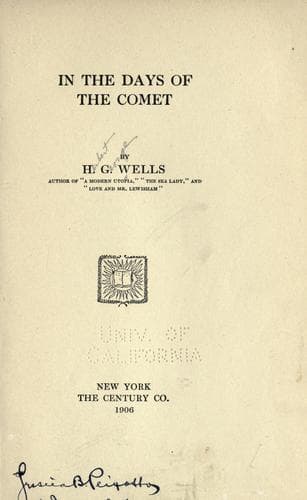
In the Days of the CometWells, H. G. (Herbert George)
Science
In the Days of the Comet
Wells, H. G. (Herbert George)
Comets -- Collisions with Earth -- Fiction; Political fiction; Science fiction; Utopian fiction; Utopias -- Fiction
He turned to me. “If one had decided all this muddle shall end! If one
had taken it, as an artist takes his clay, as a man who builds takes
site and stone, and made———” He flung out his big broad hand at the
glories of sky and sea, and drew a deep breath, “something to fit that
setting.”
He added in explanation, “Then there wouldn’t have been such stories as
yours at all, you know. . . .”
“Tell me more about it,” he said, “tell me all about yourself. I feel
all these things have passed away, all these things are to be changed
for ever. . . . You won’t be what you have been from this time forth.
All the things you have done—don’t matter now. To us, at any rate, they
don’t matter at all. We have met, who were separated in that darkness
behind us. Tell me.
“Yes,” he said; and I told my story straight and as frankly as I have
told it to you. “And there, where those little skerries of weed rock
run out to the ebb, beyond the headland, is Bungalow village. What did
you do with your pistol?”
“I left it lying there—among the barley.”
He glanced at me from under his light eyelashes. “If others feel like
you and I,” he said, “there’ll be a lot of pistols left among the
barley to-day. . . .”
So we talked, I and that great, strong man, with the love of brothers
so plain between us it needed not a word. Our souls went out to one
another in stark good faith; never before had I had anything but a
guarded watchfulness for any fellow-man. Still I see him, upon that
wild desolate beach of the ebb tide, I see him leaning against the
shelly buttress of a groin, looking down at the poor drowned sailor
whose body we presently found. For we found a newly drowned man who had
just chanced to miss this great dawn in which we rejoiced. We found him
lying in a pool of water, among brown weeds in the dark shadow of the
timberings. You must not overrate the horrors of the former days; in
those days it was scarcely more common to see death in England than it
would be to-day. This dead man was a sailor from the _Rother Adler_,
the great German battleship that—had we but known it—lay not four miles
away along the coast amidst ploughed-up mountains of chalk ooze, a torn
and battered mass of machinery, wholly submerged at high water, and
holding in its interstices nine hundred drowned brave men, all strong
and skilful, all once capable of doing fine things. . . .
Public-domain text, read in full here on John Shaqi.
Reviews
Reviews
No reviews yet
Be the first to share your thoughts on this work.
Elsewhere in the archive
Join the Discussion
Join the discussion
Sign in to leave a comment or review.
Sign InorCreate an account