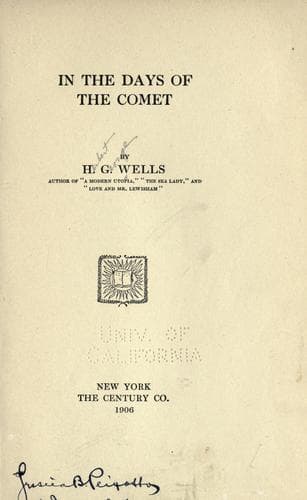
In the Days of the CometWells, H. G. (Herbert George)
Science
In the Days of the Comet
Wells, H. G. (Herbert George)
Comets -- Collisions with Earth -- Fiction; Political fiction; Science fiction; Utopian fiction; Utopias -- Fiction
The great voice of material Fate cried Halt! And in the midst of the
play the actors staggered, dropped, and were still. The figure runs
from my pen. In New York that very thing occurred. Most of the
theatrical audiences dispersed, but in two crowded houses the company,
fearing a panic, went on playing amidst the gloom, and the people,
trained by many a previous disaster, stuck to their seats. There they
sat, the back rows only moving a little, and there, in disciplined
lines, they drooped and failed, nodded, and fell forward or slid down
upon the floor. I am told by Parload—though indeed I know nothing of
the reasoning on which his confidence rests—-that within an hour of the
great moment of impact the first green modification of nitrogen had
dissolved and passed away, leaving the air as translucent as ever. The
rest of that wonderful interlude was clear, had any had eyes to see its
clearness. In London it was night, but in New York, for example, people
were in the full bustle of the evening’s enjoyment, in Chicago they
were sitting down to dinner, the whole world was abroad. The moonlight
must have illuminated streets and squares littered with crumpled
figures, through which such electric cars as had no automatic brakes
had ploughed on their way until they were stopped by the fallen bodies.
People lay in their dress clothes, in dining-rooms, restaurants, on
staircases, in halls, everywhere just as they had been overcome. Men
gambling, men drinking, thieves lurking in hidden places, sinful
couples, were caught, to arise with awakened mind and conscience amidst
the disorder of their sin. America the comet reached in the full tide
of evening life, but Britain lay asleep. But as I have told, Britain
did not slumber so deeply but that she was in the full tide of what may
have been battle and a great victory. Up and down the North Sea her
warships swept together like a net about their foes. On land, too, that
night was to have decided great issues. The German camps were under
arms from Redingen to Markirch, their infantry columns were lying in
swathes like mown hay, in arrested night march on every track between
Longuyon and Thiancourt, and between Avricourt and Donen. The hills
beyond Spincourt were dusted thick with hidden French riflemen; the
thin lash of the French skirmishers sprawled out amidst spades and
unfinished rifle-pits in coils that wrapped about the heads of the
German columns, thence along the Vosges watershed and out across the
frontier near Belfort nearly to the Rhine. . . .
The Hungarian, the Italian peasant, yawned and thought the morning
dark, and turned over to fall into a dreamless sleep; the Mahometan
world spread its carpet and was taken in prayer. And in Sydney, in
Melbourne, in New Zealand, the thing was a fog in the afternoon, that
scattered the crowd on race-courses and cricket-fields, and stopped the
unloading of shipping and brought men out from their afternoon rest to
stagger and litter the streets. . . .
§ 2
Public-domain text, read in full here on John Shaqi.
Reviews
Reviews
No reviews yet
Be the first to share your thoughts on this work.
Elsewhere in the archive
Join the Discussion
Join the discussion
Sign in to leave a comment or review.
Sign InorCreate an account