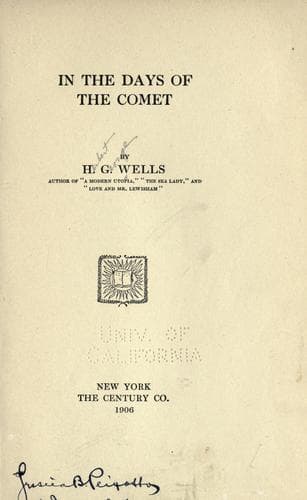
In the Days of the CometWells, H. G. (Herbert George)
Science
In the Days of the Comet
Wells, H. G. (Herbert George)
Comets -- Collisions with Earth -- Fiction; Political fiction; Science fiction; Utopian fiction; Utopias -- Fiction
The clocks of the city churches, one pursuing another, struck four. The
staffs, crumpled and disheveled, but with a strange refreshment in
their veins, stood about the damaged machinery, marveling and
questioning; the editor read his overnight headlines with incredulous
laughter. There was much involuntary laughter that morning. Outside,
the mail men patted the necks and rubbed the knees of their awakening
horses. . . .
Then, you know, slowly and with much conversation and doubt, they set
about to produce the paper.
Imagine those bemused, perplexed people, carried on by the inertia of
their old occupations and doing their best with an enterprise that had
suddenly become altogether extraordinary and irrational. They worked
amidst questionings, and yet light-heartedly. At every stage there must
have been interruptions for discussion. The paper only got down to
Menton five days late.
§ 4
Then let me give you a vivid little impression I received of a certain
prosaic person, a grocer, named Wiggins, and how he passed through the
Change. I heard this man’s story in the post-office at Menton, when, in
the afternoon of the First Day, I bethought me to telegraph to my
mother. The place was also a grocer’s shop, and I found him and the
proprietor talking as I went in. They were trade competitors, and
Wiggins had just come across the street to break the hostile silence of
a score of years. The sparkle of the Change was in their eyes, their
slightly flushed cheeks, their more elastic gestures, spoke of new
physical influences that had invaded their beings.
“It did us no good, all our hatred,” Mr. Wiggins said to me, explaining
the emotion of their encounter; “it did our customers no good. I’ve
come to tell him that. You bear that in mind, young man, if ever you
come to have a shop of your own. It was a sort of stupid bitterness
possessed us, and I can’t make out we didn’t see it before in that
light. Not so much downright wickedness it wasn’t as stupidity. A
stupid jealousy! Think of it!—two human beings within a stone’s throw,
who have not spoken for twenty years, hardening our hearts against each
other!”
“I can’t think how we came to such a state, Mr. Wiggins,” said the
other, packing tea into pound packets out of mere habit as he spoke.
“It was wicked pride and obstinacy. We _knew_ it was foolish all the
time.”
I stood affixing the adhesive stamp to my telegram.
“Only the other morning,” he went on to me, “I was cutting French eggs.
Selling at a loss to do it. He’d marked down with a great staring
ticket to ninepence a dozen—I saw it as I went past. Here’s my answer!”
He indicated a ticket. “‘Eightpence a dozen—same as sold elsewhere for
ninepence.’ A whole penny down, bang off! Just a touch above cost—if
that—and even then———” He leant over the counter to say impressively,
“_Not the same eggs!_”
“Now, what people in their senses would do things like that?” said Mr.
Wiggins.
Public-domain text, read in full here on John Shaqi.
Reviews
Reviews
No reviews yet
Be the first to share your thoughts on this work.
Elsewhere in the archive
Join the Discussion
Join the discussion
Sign in to leave a comment or review.
Sign InorCreate an account