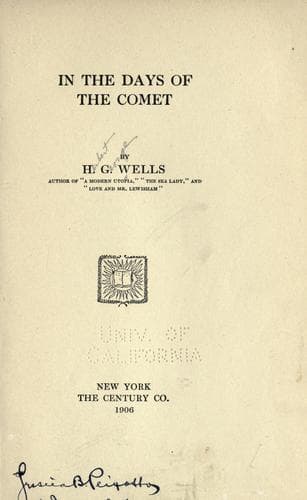
In the Days of the CometWells, H. G. (Herbert George)
Science
In the Days of the Comet
Wells, H. G. (Herbert George)
Comets -- Collisions with Earth -- Fiction; Political fiction; Science fiction; Utopian fiction; Utopias -- Fiction
We common people of the old time based our conception of our statesmen
almost entirely on the caricatures that formed the most powerful weapon
in political controversy. Like almost every main feature of the old
condition of things these caricatures were an unanticipated
development, they were a sort of parasitic outgrowth from, which had
finally altogether replaced, the thin and vague aspirations of the
original democratic ideals. They presented not only the personalities
who led our public life, but the most sacred structural conceptions of
that life, in ludicrous, vulgar, and dishonorable aspects that in the
end came near to destroying entirely all grave and honorable emotion or
motive toward the State. The state of Britain was represented nearly
always by a red-faced, purse-proud farmer with an enormous belly, that
fine dream of freedom, the United States, by a cunning, lean-faced
rascal in striped trousers and a blue coat. The chief ministers of
state were pickpockets, washerwomen, clowns, whales, asses, elephants,
and what not, and issues that affected the welfare of millions of men
were dressed and judged like a rally in some idiotic pantomime. A
tragic war in South Africa, that wrecked many thousand homes,
impoverished two whole lands, and brought death and disablement to
fifty thousand men, was presented as a quite comical quarrel between a
violent queer being named Chamberlain, with an eyeglass, an orchid, and
a short temper, and “old Kroojer,” an obstinate and very cunning old
man in a shocking bad hat. The conflict was carried through in a mood
sometimes of brutish irritability and sometimes of lax slovenliness,
the merry peculator plied his trade congenially in that asinine
squabble, and behind these fooleries and masked by them, marched
Fate—until at last the clowning of the booth opened and revealed—hunger
and suffering, brands burning and swords and shame. . . . These men had
come to fame and power in that atmosphere, and to me that day there was
the oddest suggestion in them of actors who have suddenly laid aside
grotesque and foolish parts; the paint was washed from their faces, the
posing put aside.
Public-domain text, read in full here on John Shaqi.
Reviews
Reviews
No reviews yet
Be the first to share your thoughts on this work.
Elsewhere in the archive
Join the Discussion
Join the discussion
Sign in to leave a comment or review.
Sign InorCreate an account