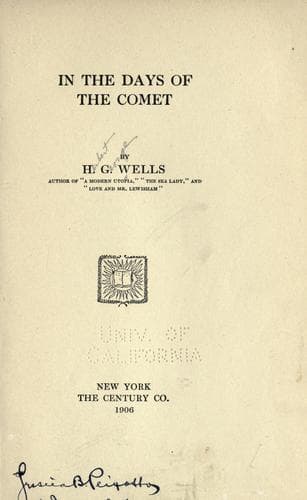
In the Days of the CometWells, H. G. (Herbert George)
Science
In the Days of the Comet
Wells, H. G. (Herbert George)
Comets -- Collisions with Earth -- Fiction; Political fiction; Science fiction; Utopian fiction; Utopias -- Fiction
Let me try to give the chief things that had vanished from their minds.
There was, first, the ancient system of “ownership” that made such an
extraordinary tangle of our administration of the land upon which we
lived. In the old time no one believed in that as either just or
ideally convenient, but every one accepted it. The community which
lived upon the land was supposed to have waived its necessary
connection with the land, except in certain limited instances of
highway and common. All the rest of the land was cut up in the maddest
way into patches and oblongs and triangles of various sizes between a
hundred square miles and a few acres, and placed under the nearly
absolute government of a series of administrators called landowners.
They owned the land almost as a man now owns his hat; they bought it
and sold it, and cut it up like cheese or ham; they were free to ruin
it, or leave it waste, or erect upon it horrible and devastating
eyesores. If the community needed a road or a tramway, if it wanted a
town or a village in any position, nay, even if it wanted to go to and
fro, it had to do so by exorbitant treaties with each of the monarchs
whose territory was involved. No man could find foothold on the face of
the earth until he had paid toll and homage to one of them. They had
practically no relations and no duties to the nominal, municipal, or
national Government amidst whose larger areas their own dominions lay.
. . . This sounds, I know, like a lunatic’s dream, but mankind was that
lunatic; and not only in the old countries of Europe and Asia, where
this system had arisen out of the rational delegation of local control
to territorial magnates, who had in the universal baseness of those
times at last altogether evaded and escaped their duties, did it
obtain, but the “new countries,” as we called them then—the United
States of America, the Cape Colony, Australia, and New Zealand—spent
much of the nineteenth century in the frantic giving away of land for
ever to any casual person who would take it. Was there coal, was there
petroleum or gold, was there rich soil or harborage, or the site for a
fine city, these obsessed and witless Governments cried out for
scramblers, and a stream of shabby, tricky, and violent adventurers set
out to found a new section of the landed aristocracy of the world.
After a brief century of hope and pride, the great republic of the
United States of America, the hope as it was deemed of mankind, became
for the most part a drifting crowd of landless men; landlords and
railway lords, food lords (for the land is food) and mineral lords
ruled its life, gave it Universities as one gave coins to a mendicant,
and spent its resources upon such vain, tawdry, and foolish luxuries as
the world had never seen before. Here was a thing none of these
statesmen before the Change would have regarded as anything but the
natural order of the world, which not one of them now regarded as
Public-domain text, read in full here on John Shaqi.
Reviews
Reviews
No reviews yet
Be the first to share your thoughts on this work.
Elsewhere in the archive
Join the Discussion
Join the discussion
Sign in to leave a comment or review.
Sign InorCreate an account