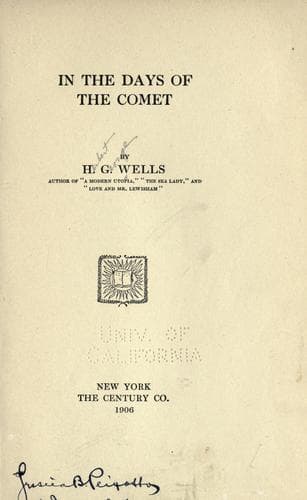
In the Days of the CometWells, H. G. (Herbert George)
Science
In the Days of the Comet
Wells, H. G. (Herbert George)
Comets -- Collisions with Earth -- Fiction; Political fiction; Science fiction; Utopian fiction; Utopias -- Fiction
The new strange brightness of the world was all the brighter there, for
the host of dark distressful memories, of darkened childhood, toilsome
youth, embittered adolescence that wove about the place for me. It
seemed to me that I saw morning there for the first time. No chimneys
smoked that day, no furnaces were burning, the people were busy with
other things. The clear strong sun, the sparkle in the dustless air,
made a strange gaiety in the narrow streets. I passed a number of
smiling people coming home from the public breakfasts that were given
in the Town Hall until better things could be arranged, and happened on
Parload among them. “You were right about that comet,” I sang out at
the sight of him; and he came toward me and clasped my hand.
“What are people doing here?” said I.
“They’re sending us food from outside,” he said, “and we’re going to
level all these slums—and shift into tents on to the moors;” and he
began to tell me of many things that were being arranged, the Midland
land committees had got to work with remarkable celerity and directness
of purpose, and the redistribution of population was already in its
broad outlines planned. He was working at an improvised college of
engineering. Until schemes of work were made out, almost every one was
going to school again to get as much technical training as they could
against the demands of the huge enterprise of reconstruction that was
now beginning.
He walked with me to my door, and there I met old Pettigrew coming down
the steps. He looked dusty and tired, but his eye was brighter than it
used to be, and he carried in a rather unaccustomed manner, a workman’s
tool basket.
“How’s the rheumatism, Mr. Pettigrew?” I asked.
“Dietary,” said old Pettigrew, “can work wonders. . . .” He looked me
in the eye. “These houses,” he said, “will have to come down, I
suppose, and our notions of property must undergo very considerable
revision—in the light of reason; but meanwhile I’ve been doing
something to patch that disgraceful roof of mine! To think that I could
have dodged and evaded———”
He raised a deprecatory hand, drew down the loose corners of his ample
mouth, and shook his old head.
“The past is past, Mr. Pettigrew.”
“Your poor dear mother! So good and honest a woman! So simple and kind
and forgiving! To think of it! My dear young man!”—he said it
manfully—“I’m ashamed.”
“The whole world blushed at dawn the other day, Mr. Pettigrew,” I said,
“and did it very prettily. That’s over now. God knows, who is _not_
ashamed of all that came before last Tuesday.”
I held out a forgiving hand, naively forgetful that in this place I was
a thief, and he took it and went his way, shaking his head and
repeating he was ashamed, but I think a little comforted.
The door opened and my poor old mother’s face, marvelously cleaned,
appeared. “Ah, Willie, boy! _You_. You!”
I ran up the steps to her, for I feared she might fall.
How she clung to me in the passage, the dear woman! . . .
Public-domain text, read in full here on John Shaqi.
Reviews
Reviews
No reviews yet
Be the first to share your thoughts on this work.
Elsewhere in the archive
Join the Discussion
Join the discussion
Sign in to leave a comment or review.
Sign InorCreate an account