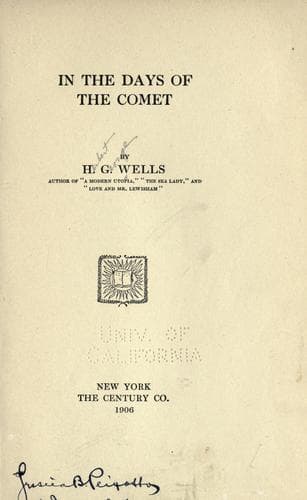
In the Days of the CometWells, H. G. (Herbert George)
Science
In the Days of the Comet
Wells, H. G. (Herbert George)
Comets -- Collisions with Earth -- Fiction; Political fiction; Science fiction; Utopian fiction; Utopias -- Fiction
We went to the council of our group—commune it was then called—and she
was given me in marriage, and within a year she had borne me a son. We
saw much of one another, and talked ourselves very close together. My
faithful friend she became and has been always, and for a time we were
passionate lovers. Always she has loved me and kept my soul full of
tender gratitude and love for her; always when we met our hands and
eyes clasped in friendly greeting, all through our lives from that hour
we have been each other’s secure help and refuge, each other’s
ungrudging fastness of help and sweetly frank and open speech. . . .
And after a little while my love and desire for Nettie returned as
though it had never faded away.
No one will have a difficulty now in understanding how that could be,
but in the evil days of the world malaria, that would have been held to
be the most impossible thing. I should have had to crush that second
love out of my thoughts, to have kept it secret from Anna, to have lied
about it to all the world. The old-world theory was there was only one
love—we who float upon a sea of love find that hard to understand. The
whole nature of a man was supposed to go out to the one girl or woman
who possessed him, her whole nature to go out to him. Nothing was left
over—it was a discreditable thing to have any overplus at all. They
formed a secret secluded system of two, two and such children as she
bore him. All other women he was held bound to find no beauty in, no
sweetness, no interest; and she likewise, in no other man. The old-time
men and women went apart in couples, into defensive little houses, like
beasts into little pits, and in these “homes” they sat down purposing
to love, but really coming very soon to jealous watching of this
extravagant mutual proprietorship. All freshness passed very speedily
out of their love, out of their conversation, all pride out of their
common life. To permit each other freedom was blank dishonor. That I
and Anna should love, and after our love-journey together, go about our
separate lives and dine at the public tables, until the advent of her
motherhood, would have seemed a terrible strain upon our unmitigable
loyalty. And that I should have it in me to go on loving Nettie—who
loved in different manner both Verrall and me—would have outraged the
very quintessence of the old convention.
Public-domain text, read in full here on John Shaqi.
Reviews
Reviews
No reviews yet
Be the first to share your thoughts on this work.
Elsewhere in the archive
Join the Discussion
Join the discussion
Sign in to leave a comment or review.
Sign InorCreate an account