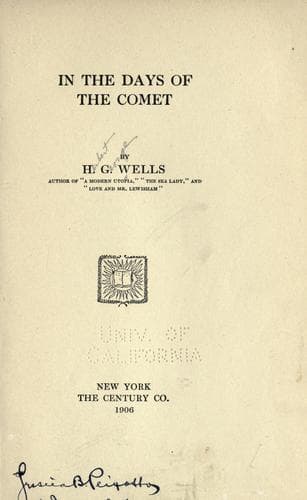
In the Days of the CometWells, H. G. (Herbert George)
Science
In the Days of the Comet
Wells, H. G. (Herbert George)
Comets -- Collisions with Earth -- Fiction; Political fiction; Science fiction; Utopian fiction; Utopias -- Fiction
There was an air of culture about his room that always cowed me, and
that made me constrained even on this occasion. The table under the
window was littered with photographic material and the later albums of
his continental souvenirs, and on the American cloth trimmed shelves
that filled the recesses on either side of the fireplace were what I
used to think in those days a quite incredible number of books—perhaps
eight hundred altogether, including the reverend gentleman’s photograph
albums and college and school text-books. This suggestion of learning
was enforced by the little wooden shield bearing a college coat-of-arms
that hung over the looking-glass, and by a photograph of Mr. Gabbitas
in cap and gown in an Oxford frame that adorned the opposite wall. And
in the middle of that wall stood his writing-desk, which I knew to have
pigeon-holes when it was open, and which made him seem not merely
cultured but literary. At that he wrote sermons, composing them
himself!
“Yes,” he said, taking possession of the hearthrug, “the war had to
come sooner or later. If we smash their fleet for them now; well,
there’s an end to the matter!”
He stood on his toes and then bumped down on his heels, and looked
blandly through his spectacles at a water-color by his sister—the
subject was a bunch of violets—above the sideboard which was his pantry
and tea-chest and cellar. “Yes,” he said as he did so.
I coughed, and wondered how I might presently get away.
He invited me to smoke—that queer old practice!—and then when I
declined, began talking in a confidential tone of this “dreadful
business” of the strikes. “The war won’t improve _that_ outlook,” he
said, and was very grave for a moment.
He spoke of the want of thought for their wives and children shown by
the colliers in striking merely for the sake of the union, and this
stirred me to controversy, and distracted me a little from my
resolution to escape.
“I don’t quite agree with that,” I said, clearing my throat. “If the
men didn’t strike for the union now, if they let that be broken up,
where would they be when the pinch of reductions did come?”
To which he replied that they couldn’t expect to get top-price wages
when the masters were selling bottom-price coal. I replied, “That isn’t
it. The masters don’t treat them fairly. They have to protect
themselves.”
To which Mr. Gabbitas answered, “Well, I don’t know. I’ve been in the
Four Towns some time, and I must say I don’t think the balance of
injustice falls on the masters’ side.”
“It falls on the men,” I agreed, wilfully misunderstanding him.
And so we worked our way toward an argument. “Confound this argument!”
I thought; but I had no skill in self-extraction, and my irritation
crept into my voice. Three little spots of color came into the cheeks
and nose of Mr. Gabbitas, but his voice showed nothing of his ruffled
temper.
Public-domain text, read in full here on John Shaqi.
Reviews
Reviews
No reviews yet
Be the first to share your thoughts on this work.
Elsewhere in the archive
Join the Discussion
Join the discussion
Sign in to leave a comment or review.
Sign InorCreate an account