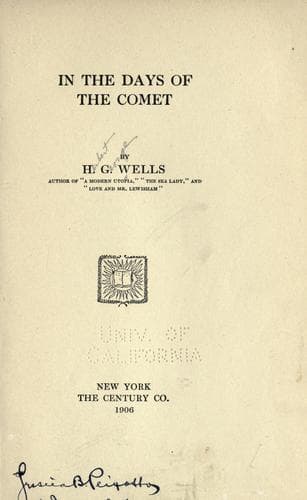
In the Days of the CometWells, H. G. (Herbert George)
Science
In the Days of the Comet
Wells, H. G. (Herbert George)
Comets -- Collisions with Earth -- Fiction; Political fiction; Science fiction; Utopian fiction; Utopias -- Fiction
Faith we can understand to-day, all men live by faith, but in the old
time every one confused quite hopelessly Faith and a forced, incredible
Belief in certain pseudo-concrete statements. I am inclined to say that
neither believers nor unbelievers had faith as we understand it—they
had insufficient intellectual power. They could not trust unless they
had something to see and touch and say, like their barbarous ancestors
who could not make a bargain without exchange of tokens. If they no
longer worshipped stocks and stones, or eked out their needs with
pilgrimages and images, they still held fiercely to audible images, to
printed words and formulae.
But why revive the echoes of the ancient logomachies?
Suffice it that we lost our tempers very readily in pursuit of God and
Truth, and said exquisitely foolish things on either side. And on the
whole—from the impartial perspective of my three and seventy years—I
adjudicate that if my dialectic was bad, that of the Rev. Gabbitas was
altogether worse.
Little pink spots came into his cheeks, a squealing note into his
voice. We interrupted each other more and more rudely. We invented
facts and appealed to authorities whose names I mispronounced; and,
finding Gabbitas shy of the higher criticism and the Germans, I used
the names of Karl Marx and Engels as Bible exegetes with no little
effect. A silly wrangle! a preposterous wrangle!—you must imagine our
talk becoming louder, with a developing quarrelsome note—my mother no
doubt hovering on the staircase and listening in alarm as who should
say, “My dear, don’t offend it! Oh, don’t offend it! Mr. Gabbitas
enjoys its friendship. Try to think whatever Mr. Gabbitas says”—though
we still kept in touch with a pretence of mutual deference. The ethical
superiority of Christianity to all other religions came to the fore—I
know not how. We dealt with the matter in bold, imaginative
generalizations, because of the insufficiency of our historical
knowledge. I was moved to denounce Christianity as the ethic of slaves,
and declare myself a disciple of a German writer of no little vogue in
those days, named Nietzsche.
For a disciple I must confess I was particularly ill acquainted with
the works of the master. Indeed, all I knew of him had come to me
through a two-column article in _The Clarion_ for the previous week. .
. . But the Rev. Gabbitas did not read _The Clarion_.
I am, I know, putting a strain upon your credulity when I tell you that
I now have little doubt that the Rev. Gabbitas was absolutely ignorant
even of the name of Nietzsche, although that writer presented a
separate and distinct attitude of attack upon the faith that was in the
reverend gentleman’s keeping.
“I’m a disciple of Nietzsche,” said I, with an air of extensive
explanation.
He shied away so awkwardly at the name that I repeated it at once.
“But do you know what Nietzsche says?” I pressed him viciously.
Public-domain text, read in full here on John Shaqi.
Reviews
Reviews
No reviews yet
Be the first to share your thoughts on this work.
Elsewhere in the archive
Join the Discussion
Join the discussion
Sign in to leave a comment or review.
Sign InorCreate an account