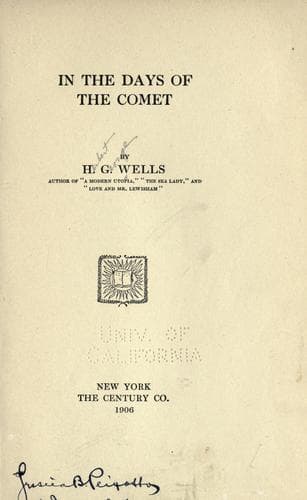
In the Days of the CometWells, H. G. (Herbert George)
Science
In the Days of the Comet
Wells, H. G. (Herbert George)
Comets -- Collisions with Earth -- Fiction; Political fiction; Science fiction; Utopian fiction; Utopias -- Fiction
I was not very greatly excited or alarmed then. Suppose, I reasoned,
that by some accident the curate goes to that drawer at once: will he
be certain to miss four out of ten or eleven sovereigns? If he does,
will he at once think I have taken them? If he does, will he act at
once or wait for my return? If he acts at once, will he talk to my
mother or call in the police? Then there are a dozen roads and even
railways out of the Clayton region, how is he to know which I have
taken? Suppose he goes straight at once to the right station, they will
not remember my departure for the simple reason that I didn’t depart.
But they may remember about Shaphambury? It was unlikely.
I resolved not to go directly to Shaphambury from Birmingham, but to go
thence to Monkshampton, thence to Wyvern, and then come down on
Shaphambury from the north. That might involve a night at some
intermediate stopping-place but it would effectually conceal me from
any but the most persistent pursuit. And this was not a case of murder
yet, but only the theft of four sovereigns.
I had argued away all anxiety before I reached Clayton Crest.
At the Crest I looked back. What a world it was! And suddenly it came
to me that I was looking at this world for the last time. If I overtook
the fugitives and succeeded, I should die with them—or hang. I stopped
and looked back more attentively at that wide ugly valley.
It was my native valley, and I was going out of it, I thought never to
return, and yet in that last prospect, the group of towns that had
borne me and dwarfed and crippled and made me, seemed, in some
indefinable manner, strange. I was, perhaps, more used to seeing it
from this comprehensive view-point when it was veiled and softened by
night; now it came out in all its weekday reek, under a clear afternoon
sun. That may account a little for its unfamiliarity. And perhaps, too,
there was something in the emotions through which I had been passing
for a week and more, to intensify my insight, to enable me to pierce
the unusual, to question the accepted. But it came to me then, I am
sure, for the first time, how promiscuous, how higgledy-piggledy was
the whole of that jumble of mines and homes, collieries and potbanks,
railway yards, canals, schools, forges and blast furnaces, churches,
chapels, allotment hovels, a vast irregular agglomeration of ugly
smoking accidents in which men lived as happy as frogs in a dustbin.
Each thing jostled and damaged the other things about it, each thing
ignored the other things about it; the smoke of the furnace defiled the
potbank clay, the clatter of the railway deafened the worshipers in
church, the public-house thrust corruption at the school doors, the
dismal homes squeezed miserably amidst the monstrosities of
industrialism, with an effect of groping imbecility. Humanity choked
amidst its products, and all its energy went in increasing its
disorder, like a blind stricken thing that struggles and sinks in a
morass.
Public-domain text, read in full here on John Shaqi.
Reviews
Reviews
No reviews yet
Be the first to share your thoughts on this work.
Elsewhere in the archive
Join the Discussion
Join the discussion
Sign in to leave a comment or review.
Sign InorCreate an account