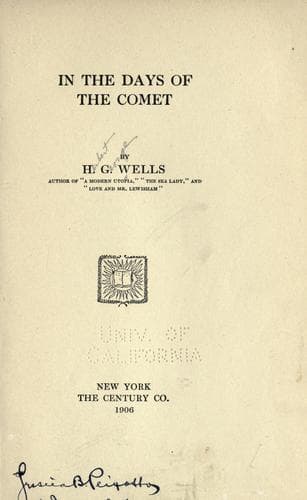
In the Days of the CometWells, H. G. (Herbert George)
Science
In the Days of the Comet
Wells, H. G. (Herbert George)
Comets -- Collisions with Earth -- Fiction; Political fiction; Science fiction; Utopian fiction; Utopias -- Fiction
I bought a paper, went on to the railway station reading such details
as were given of this triumph of the old civilization, of the blowing
up of this great iron ship, full of guns and explosives and the most
costly and beautiful machinery of which that time was capable, together
with nine hundred able-bodied men, all of them above the average, by a
contact mine towed by a German submarine. I read myself into a fever of
warlike emotions. Not only did I forget the meteor, but for a time I
forgot even the purpose that took me on to the railway station, bought
my ticket, and was now carrying me onward to Shaphambury.
So the hot day came to its own again, and people forgot the night.
Each night, there shone upon us more and more insistently, beauty,
wonder, the promise of the deeps, and we were hushed, and marveled for
a space. And at the first gray sounds of dawn again, at the shooting of
bolts and the noise of milk-carts, we forgot, and the dusty habitual
day came yawning and stretching back again. The stains of coal smoke
crept across the heavens, and we rose to the soiled disorderly routine
of life.
“Thus life has always been,” we said; “thus it will always be.”
The glory of those nights was almost universally regarded as
spectacular merely. It signified nothing to us. So far as western
Europe went, it was only a small and ignorant section of the lower
classes who regarded the comet as a portent of the end of the world.
Abroad, where there were peasantries, it was different, but in England
the peasantry had already disappeared. Every one read. The newspaper,
in the quiet days before our swift quarrel with Germany rushed to its
climax, had absolutely dispelled all possibilities of a panic in this
matter. The very tramps upon the high-roads, the children in the
nursery, had learnt that at the utmost the whole of that shining cloud
could weigh but a few score tons. This fact had been shown quite
conclusively by the enormous deflections that had at last swung it
round squarely at our world. It had passed near three of the smallest
asteroids without producing the minutest perceptible deflection in
their course; while, on its own part, it had described a course through
nearly three degrees. When it struck our earth there was to be a
magnificent spectacle, no doubt, for those who were on the right side
of our planet to see, but beyond that nothing. It was doubtful whether
we were on the right side. The meteor would loom larger and larger in
the sky, but with the umbra of our earth eating its heart of brightness
out, and at last it would be the whole sky, a sky of luminous green
clouds, with a white brightness about the horizon, west and east. Then
a pause—a pause of not very exactly definite duration—and then, no
doubt, a great blaze of shooting stars. They might be of some unwonted
color because of the unknown element that line in the green revealed.
For a little while the zenith would spout shooting stars. Some, it was
Public-domain text, read in full here on John Shaqi.
Reviews
Reviews
No reviews yet
Be the first to share your thoughts on this work.
Elsewhere in the archive
Join the Discussion
Join the discussion
Sign in to leave a comment or review.
Sign InorCreate an account