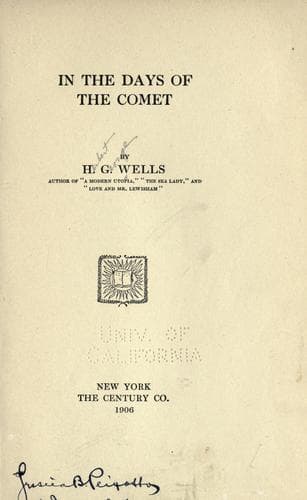
In the Days of the CometWells, H. G. (Herbert George)
Science
In the Days of the Comet
Wells, H. G. (Herbert George)
Comets -- Collisions with Earth -- Fiction; Political fiction; Science fiction; Utopian fiction; Utopias -- Fiction
So soon as I arrived I made a systematic exploration of Shaphambury. To
this day I retain the clearest memories of the plan I shaped out then,
and how my inquiries were incommoded by the overpowering desire of
every one to talk of the chances of a German raid, before the Channel
Fleet got round to us. I slept at a small public-house in a Shaphambury
back street on Sunday night. I did not get on to Shaphambury from
Wyvern until two in the afternoon, because of the infrequency of Sunday
trains, and I got no clue whatever until late in the afternoon of
Monday. As the little local train bumped into sight of the place round
the curve of a swelling hill, one saw a series of undulating grassy
spaces, amidst which a number of conspicuous notice-boards appealed to
the eye and cut up the distant sea horizon. Most of these referred to
comestibles or to remedies to follow the comestibles; and they were
colored with a view to be memorable rather than beautiful, to “stand
out” amidst the gentle grayish tones of the east coast scenery. The
greater number, I may remark, of the advertisements that were so
conspicuous a factor in the life of those days, and which rendered our
vast tree-pulp newspapers possible, referred to foods, drinks, tobacco,
and the drugs that promised a restoration of the equanimity these other
articles had destroyed. Wherever one went one was reminded in glaring
letters that, after all, man was little better than a worm, that
eyeless, earless thing that burrows and lives uncomplainingly amidst
nutritious dirt, “an alimentary canal with the subservient appendages
thereto.” But in addition to such boards there were also the big black
and white boards of various grandiloquently named “estates.” The
individualistic enterprise of that time had led to the plotting out of
nearly all the country round the seaside towns into roads and
building-plots—all but a small portion of the south and east coast was
in this condition, and had the promises of those schemes been realized
the entire population of the island might have been accommodated upon
the sea frontiers. Nothing of the sort happened, of course; the whole
of this uglification of the coast-line was done to stimulate a little
foolish gambling in plots, and one saw everywhere agents’ boards in
every state of freshness and decay, ill-made exploitation roads
overgrown with grass, and here and there, at a corner, a label,
“Trafalgar Avenue,” or “Sea View Road.” Here and there, too, some small
investor, some shopman with “savings,” had delivered his soul to the
local builders and built himself a house, and there it stood,
ill-designed, mean-looking, isolated, ill-placed on a cheaply fenced
plot, athwart which his domestic washing fluttered in the breeze amidst
a bleak desolation of enterprise. Then presently our railway crossed a
high road, and a row of mean yellow brick houses—workmen’s cottages,
and the filthy black sheds that made the “allotments” of that time a
Public-domain text, read in full here on John Shaqi.
Reviews
Reviews
No reviews yet
Be the first to share your thoughts on this work.
Elsewhere in the archive
Join the Discussion
Join the discussion
Sign in to leave a comment or review.
Sign InorCreate an account