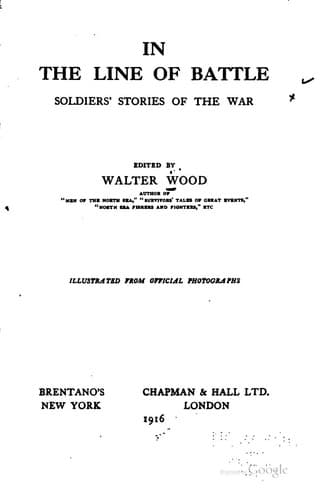
In the Line of Battle: Soldiers' Stories of the War
History
In the Line of Battle: Soldiers' Stories of the War
World War, 1914-1918 -- Personal narratives
A year’s hard training had got us more or less used to marching; yet
when we got to Bethune we were nearly all done up, for we had been on
the road three days. We eagerly sought our billets, which in my own
case happened to be an attic in an empty house. Our “cookers” followed
us, so that next morning we had a good breakfast; then we raided the
pump at the back of the house, hurried through a wash and sallied into
the street, where we saw a sight that will not be forgotten.
There was an almost continuous procession of ambulances, full of
wounded men from the Loos front; and an endless stream of men of all
regiments were walking down the street to the dressing-station. The
British soldier has a happy knack of looking at the bright side of a
gloomy picture, and even now amusement was caused by the spectacle of
one or two Scotsmen wearing Prussian Guards’ helmets and walking along
quite unconcerned about their wounds, most of which were in the arm.
In the afternoon we left our billet for the trenches. At the first
halt a party of 200 German prisoners passed us. I have never seen
such a collection of dejected, worn-out individuals. One man, who was
apparently a non-commissioned officer, leaned on the arm of one of the
guards for support, and his face was the picture of despair and misery.
Knowing what this war means to France especially, and what the French
have had to endure from Germany for over forty years, it was very
interesting to notice the attitude of quite little French children
towards the captives. These boys and girls, standing on the pavement,
insulted and spat upon the Germans, who, however, took little notice of
them.
On the road we passed some of our own Tommies, coming from the
trenches, and rejoicing in their relief. They wanted to cheer us, and
shouted, “Hurry up, chaps; there’s plenty left for you to do up there.”
They were quite right, as we soon discovered.
From Bethune we marched to the town of Vermelles, where we had our
first glimpse of the havoc caused by the enemy’s artillery fire. The
whole place was a mass of ruins, very few houses remaining intact.
What had been a town had been smashed by German guns to a vast mass
of rubbish. It was a melancholy sight, yet it strengthened the
determination to do our best to overcome the tyrants who had brought
about such widespread misery and ruin. To make the sight all the more
impressive, we distinctly heard the booming of the guns as we marched
along.
Public-domain text, read in full here on John Shaqi.
Reviews
Reviews
No reviews yet
Be the first to share your thoughts on this work.
Elsewhere in the archive
Join the Discussion
Join the discussion
Sign in to leave a comment or review.
Sign InorCreate an account